200 mA LDO with 3 V fixed rail — what the PSRR and dropout mean for your supply
The TPS79930YZUR is a 200 mA low-dropout linear regulator from Texas Instruments, delivering a fixed 3 V output from an input up to 6.5 V. The 180 mV maximum dropout at full load means the input rail needs at least 3.18 V to maintain regulation — a 3.3 V bus with 5% tolerance (3.135 V min) is too tight; a 5 V rail gives comfortable headroom. The PSRR profile — 70 dB at 100 Hz dropping to 38 dB at 100 kHz — tells you where this LDO cleans up upstream noise. At line frequencies and their harmonics the rejection is strong; above 100 kHz the attenuation rolls off, so a switching regulator running at 500 kHz or 1 MHz will push ripple through unless the LDO's output capacitor and layout manage the high-frequency impedance.
Quiescent current and protection — always-on and fault-tolerant design
The 60 µA typical quiescent current makes this LDO suitable for battery-powered circuits where the regulator itself must not drain the cell during sleep or light-load operation. The enable pin lets a system-level controller shut down the output entirely, cutting Iq to near zero when the rail is not needed. On-chip protection includes overcurrent, overtemperature, reverse polarity, and under-voltage lockout (UVLO). The UVLO prevents the output from turning on until the input is high enough to keep the pass element in regulation — useful in multi-rail power-up sequencing where the 3 V rail must not come up before the upstream supply is stable.
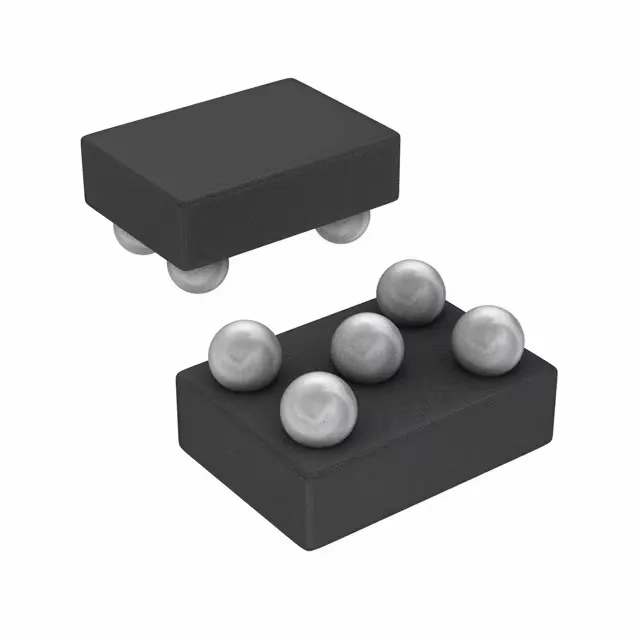
The 5-DSBGA package (0.9 mm x 1.3 mm typical, 0.5 mm pitch) is a wafer-level chip-scale package. The exposed backside is the die attach — it is not a thermal pad, so the primary heat path is through the solder balls to the PCB copper. The -40°C to 125°C operating range covers automotive under-hood and industrial ambient; the junction temperature must stay within this range at 200 mA with the dropout voltage times current as the dissipation. The fixed 3 V output and positive configuration mean no external resistor divider is needed — the output voltage is set internally.
Active lifecycle and compliance — sourcing posture
Sourced through authorized distribution and independent channels. No stock-holding claim is made; the part is quoted to order.