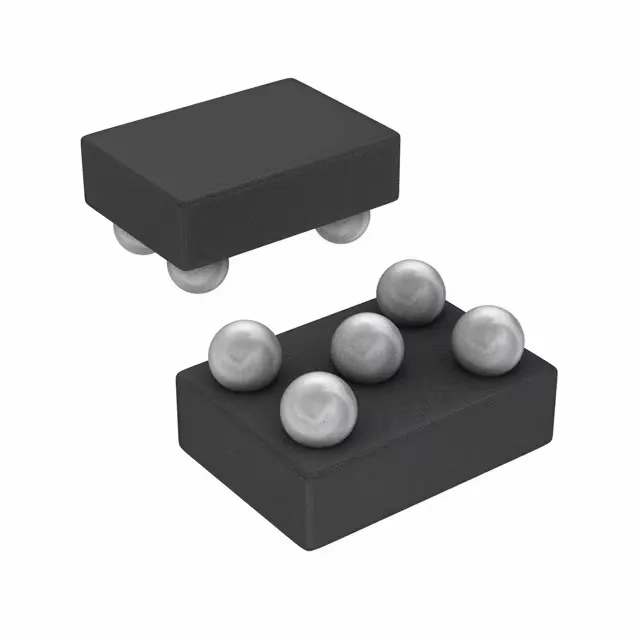
Fixed 2.5 V rail for noise-sensitive loads
The TPS79925YZUR is a 200 mA LDO with a fixed 2.5 V output — no external resistor divider needed, but the output voltage is not adjustable. The 180 mV maximum dropout at 200 mA means the input rail must stay above 2.68 V across load and temperature to keep the output in regulation. PSRR starts at 70 dB at 100 Hz and rolls off to 38 dB at 100 kHz. That profile matters when the upstream supply is a switching converter: the LDO attenuates ripple well at line frequency and the first few harmonics, but above 100 kHz the attenuation drops by nearly half — a second-stage LC filter ahead of the LDO may be needed if the switcher runs above 500 kHz.
Quiescent draw and protection set
Quiescent current is 60 µA typical — low enough for always-on rails in battery-powered gear, but not the ultra-low-Iq class (sub-1 µA) used for wake-up circuits. The enable pin lets the system shut the rail entirely when the load is idle. Protection covers over-current, over-temperature, reverse polarity, and under-voltage lockout (UVLO). The reverse polarity protection is unusual for a small LDO and saves an external series diode when the input could be reversed during assembly or field service.
5-DSBGA — layout constraints
The 5-DSBGA (0.5 mm pitch, 0.9 mm × 1.0 mm body) has no exposed thermal pad — all heat dissipates through the solder balls and board copper. For 200 mA at 3.3 V in to 2.5 V out, the power loss is 160 mW; the junction-to-board thermal resistance (RθJB) for this package is typically 80-100 °C/W, so a 2-layer board with solid ground plane under the part keeps the junction rise under 20 °C at room ambient. The 5-DSBGA requires micro-via fan-out — a 4-layer board is not mandatory, but the inner layers help spread heat. The supplier device package is 5-DSBGA; the package/case is 5-UFBGA, DSBGA, meaning the same land pattern serves both wafer-level and fine-pitch BGA variants.