85 dB PSRR — why it matters for noise-sensitive rails
The TPS78928DBVT: With 85 dB of power-supply rejection at 1 kHz, this LDO attenuates ripple from a switching pre-regulator by a factor of roughly 18,000 — enough to keep a 10 mVpp input ripple below 1 µVpp at the output, which matters for analog front-ends, ADC reference supplies, or RF bias rails.
Dropout and quiescent current — headroom and always-on budget
Maximum dropout is 0.13 V at the full 100 mA load, so a 3.0 V input rail leaves 0.07 V of headroom before the output falls out of regulation — tight but workable if the upstream rail is well-regulated. Quiescent current is 28 µA typical, low enough for battery-backed always-on domains where every microamp extends standby life.
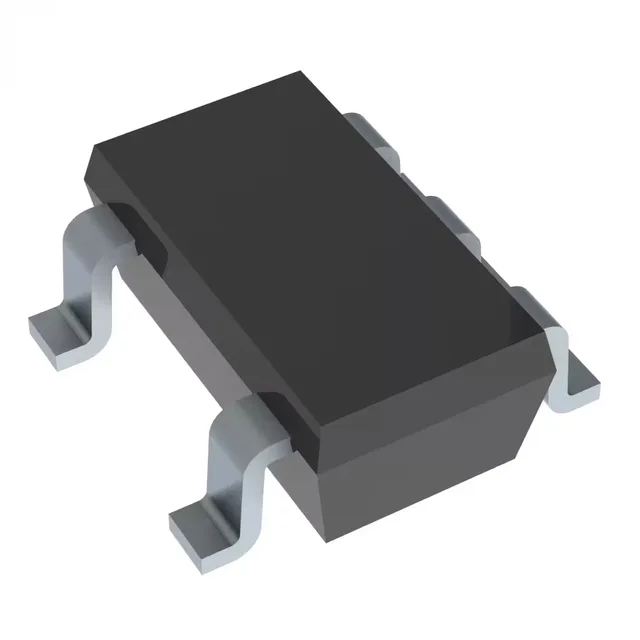
The SOT-23-5 package (SC-74A) is a standard footprint for low-current linear regulators, and the surface-mount assembly fits into compact mixed-signal boards without a dedicated thermal pad.
Protection features and control
Built-in over-current, over-temperature, and reverse-polarity protection cover the common fault conditions in a power rail — the regulator shuts down before the load or the board trace sees damage. An Enable pin lets the system designer gate the output rail for sequenced power-up or low-power sleep modes.