AEC-Q100 qualification and the under-hood thermal profile
The TPS74511PQWDRBRQ1 is a Texas Instruments automotive LDO from the AEC-Q100-qualified series, meaning it has passed the stress tests and PPAP requirements for Tier-1 ECU programs. The -40°C to 125°C operating temperature range covers the under-hood ambient band with margin for self-heating at full load.
Dropout headroom and PSRR — what they mean for the rail design
Rated 500 mA continuous output with a maximum dropout voltage of 0.6 V at that load. The input rail must stay at least 0.6 V above the 1.1 V fixed output across the full load range, or the output falls out of regulation. PSRR measures 57 dB at 1 kHz, rolling off to 35 dB at 1 MHz. Upstream switching noise above the crossover frequency — from a pre-regulator or DC-DC converter — passes through with less attenuation, so the LDO alone cannot clean a noisy rail above roughly 100 kHz without additional filtering ahead of it. Quiescent current is 36 µA typical, suited for always-on ECU blocks or sleep-mode circuits where the regulator's own draw must stay below the module's standby budget.
Wettable-flank QFN and automotive AOI inspection
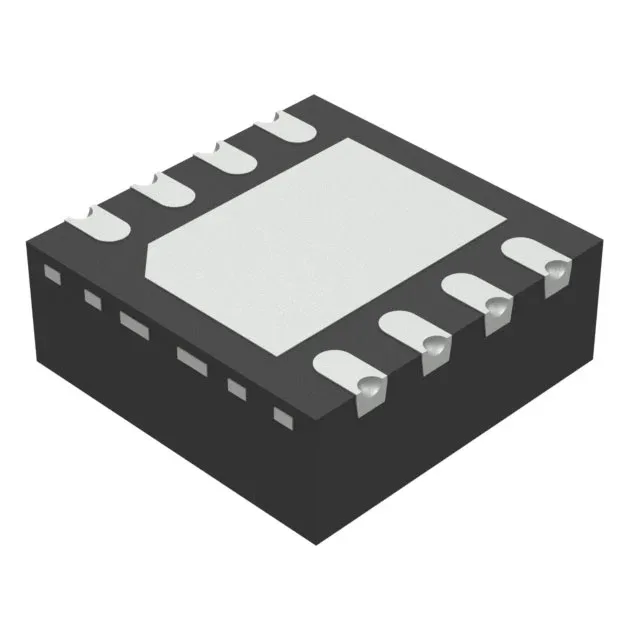
The 8-VDFN exposed-pad package (8-SON, 3x3 mm) uses a wettable-flank design. The side pads wick solder up the package edge during reflow, creating a visible fillet that automated optical inspection (AOI) can verify — a requirement for zero-defect automotive soldering processes. Surface-mount with wettable flank; the exposed thermal pad must be soldered to the PCB copper plane to achieve the rated power dissipation. The Enable control pin allows the output to be gated by a system supervisor or GPIO.
Protection features reduce external monitoring
Integrated over-current, over-temperature, and under-voltage lockout (UVLO) protection means the LDO handles fault conditions without requiring a separate supervisor IC or reset generator for the output rail. Single positive regulator, fixed 1.1 V output — no external resistor divider needed for the feedback node.