The TPS74301RGWT delivers 73 dB of power-supply rejection at 1 kHz, rolling off to 42 dB at 800 kHz. For a noise-sensitive load — a VCO supply, an ADC reference, or a SerDes PLL — this PSRR profile determines how much upstream switching ripple bleeds into the output. The 73 dB floor at 1 kHz knocks a 10 mVpp ripple down to roughly 2 µVpp at the load; above 800 kHz the rejection drops, so a downstream LC filter ahead of the LDO is worth budgeting for if the switcher runs above 1 MHz.
120 mV dropout at 1.5 A — headroom planning
Maximum dropout is 120 mV at the full 1.5 A load. If the input rail is a nominal 5.0 V that dips to 4.8 V during a transient, the LDO still holds regulation down to 3.6 V output — but a 3.3 V rail from that same 4.8 V input leaves only 1.5 V headroom, well above the dropout ceiling. The headroom margin is the input-to-output differential minus the dropout; budget at least 200 mV of margin across temperature and load to stay out of dropout. Quiescent current is 115 µA typical, rising to 1.5 mA max under full load. That 115 µA ground current is low enough for battery-powered always-on domains — a sensor node that sleeps at 10 µA system draw sees the LDO's Iq as the dominant idle load, so a load-switch on the LDO input is worth considering for sub-mA sleep modes.
Control features include Enable, Power Good, and Tracking. The Tracking pin lets the output follow an external reference ramp during power-up — useful for sequencing core and I/O rails in FPGAs that specify monotonic rise and a maximum slew rate. Power Good asserts when the output reaches ~92% of the nominal voltage, giving the downstream load a reset release signal.
20-VQFN exposed pad — thermal and board integration
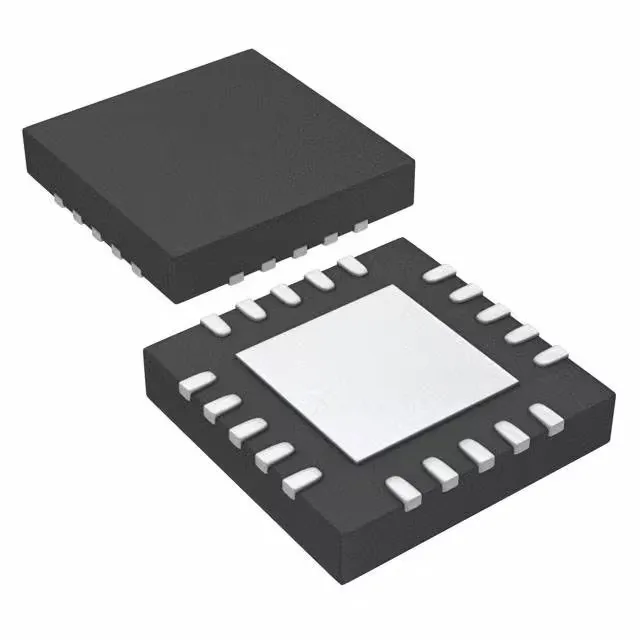
The 20-VQFN (5x5 mm) package with an exposed pad requires a thermal land on the PCB. Protection features include over-current, over-temperature, short-circuit, and under-voltage lockout (UVLO). The UVLO threshold typically sits at 1.35 V rising, so the LDO stays off until the input rail is above that level — preventing the output from tracking a brown-out input. The over-temperature shutdown trips at ~165°C typical, with 15°C of hysteresis.