PSRR and noise-sensitive supply rails
The TPS72116DBVT: PSRR is specified at 48 dB at 100 Hz — this is the ripple rejection at line frequency and its second harmonic, so the 1.6 V rail stays clean when the upstream supply carries 50/60 Hz ripple from a rectified AC source. For a 100 Hz ripple amplitude of 100 mV at the input, the output sees roughly 0.4 mV of that ripple — sufficient for analog front-ends that draw under 150 mA and need a low-noise 1.6 V reference.
Dropout voltage and headroom budget
A 2.5 V input rail, for example, leaves 0.66 V of headroom at full load, well above the dropout ceiling.
Temperature range and quiescent draw
Operating temperature spans -40°C to +125°C, covering automotive and industrial ambient requirements. Quiescent current is 120 µA typical, rising to 850 µA maximum supply current — the 120 µA Iq keeps battery drain low in always-on blocks.
Protection set and control interface
Built-in protection includes over-current, over-temperature, and reverse polarity — the reverse polarity clamp protects the regulator if the input is accidentally reversed, a feature not always present on small LDOs. An enable pin (active-high logic) allows the output to be shut down externally, reducing quiescent current to near zero when the rail is not needed.
Package and footprint
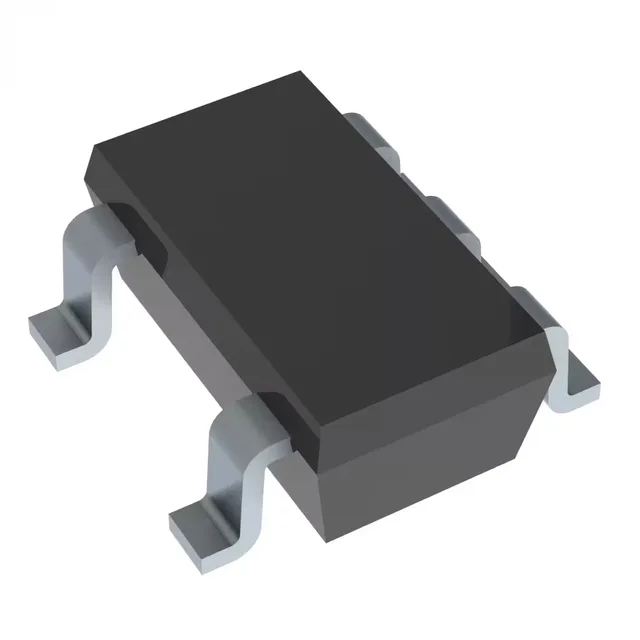
Supplied in the SOT-23-5 package (SC-74A, SOT-753), a five-pin surface-mount footprint common for small linear regulators.