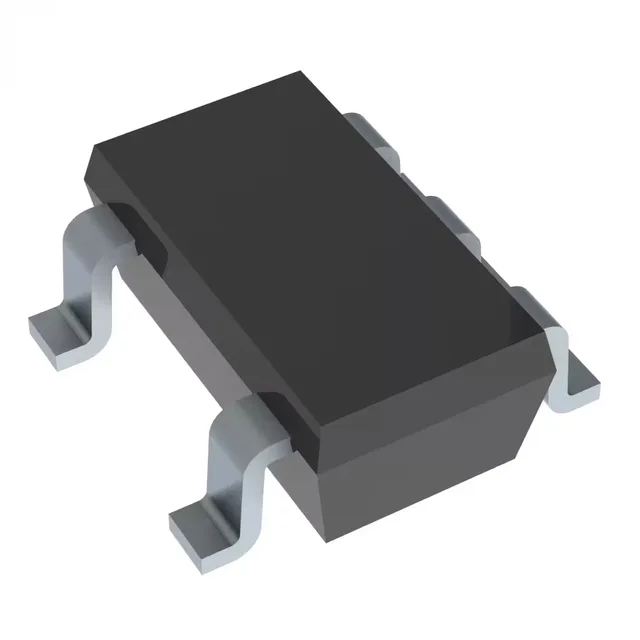
The TPS72101DBVR comes in a SOT-23-5 (SC-74A) surface-mount package, a common three-lead footprint that fits standard pick-and-place and reflow profiles. The small body saves board area but demands careful thermal layout if the part runs near its 150 mA ceiling — the copper pour under the device acts as the primary heat sink.
This is a single-output, positive adjustable LDO with an output range from 1.22 V up to 2.5 V, set by an external resistor divider. The 150 mA current rating covers low-power analog rails, sensor supplies, and auxiliary bias lines. Dropout voltage maxes at 0.24 V at full load, so a 3.3 V input rail needs only about 2.74 V headroom to hold 2.5 V regulation — useful when the input bus sags under transient load. PSRR is 48 dB at 100 Hz — this is the low-frequency ripple rejection from the input. For a 100 mVpp ripple at 100 Hz on the input, the output sees roughly 0.4 mVpp. That matters for analog front-ends where 50/60 Hz mains hum couples into the supply. Above 100 kHz the PSRR rolls off; a post-filter cap at the output helps keep high-frequency switching noise out of the load. Quiescent current is 120 µA typical, with a maximum supply current of 850 µA. The enable pin lets you shut the output off entirely, dropping Iq to near zero — useful for battery-powered gear that sleeps between bursts.
Protection and temperature range
Built-in protection covers over-current, over-temperature, and reverse polarity — the part survives a shorted output or a hot reflow without latching up.
It is RoHS3 compliant.