PSRR across the audio band — what 80 dB at 10 Hz means for a sensitive rail
The TPS70918DBVR delivers 80 dB of PSRR at 10 Hz, rolling to 52 dB at 1 kHz. That profile keeps 120 Hz ripple from a rectified mains supply attenuated by a factor of 10,000 — critical when powering an analog front-end or a precision ADC reference that cannot tolerate ripple feeding through into the signal chain. At 2.05 µA quiescent current, this LDO draws less than the self-discharge rate of a typical lithium coin cell. A sensor node that spends most of its life in sleep mode sees the battery life governed by the load, not the regulator overhead.
Wide input range and protection — survives load dump and reverse battery
Rated for 30 V maximum input, the TPS70918DBVR starts from a 12 V automotive rail that dips to 4.5 V during cold crank and survives a 60 V load-dump transient without an external clamp — the internal FET's abs-max rating covers the surge. Output is fixed at 1.8 V, delivering up to 150 mA continuous. Built-in protection includes overcurrent, overtemperature, reverse current, and under-voltage lockout (UVLO). Reverse current blocking means no external Schottky diode is needed if the output bus holds up when the input collapses — the regulator simply shuts off instead of back-feeding.
Temperature grade and package — fits under-hood and tight boards
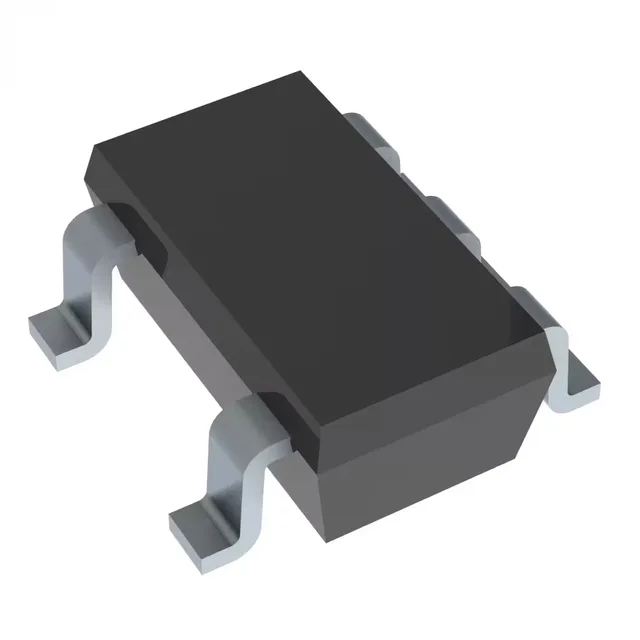
An engine-bay ECU that sees 105°C on a summer grade still has 20°C of margin before the silicon derating curve bends. Housed in a SOT-23-5 (SC-74A) package, the 0.95 mm pitch footprint fits on a two-layer board without micro-vias. The enable pin lets the system power-down the regulator to 2.05 µA quiescent — useful for a microcontroller that cuts its own supply after a deep-sleep wake.