D-CAP2™ synchronous buck controller — 350 kHz, dual rail
The TPS53125PW is a Texas Instruments D-CAP2™ synchronous buck controller delivering two independent regulated outputs from a single 4.5 V to 24 V supply rail. The 350 kHz fixed switching frequency is set internally — no external timing resistor — which simplifies the BOM and keeps the inductor and output capacitor values predictable across the line. Synchronous rectification is built in, so the external FET pair handles the high-side and low-side switching without a separate Schottky catch diode. The controller drives the transistor pair directly; the efficiency gain over a non-synchronous buck is typically 3–5 % at full load, which matters when the output current is in the 10 A+ range per rail.
Switching frequency and output configuration
The 350 kHz switching frequency is a deliberate midpoint: high enough to keep the inductor small, low enough to avoid the switching losses that climb above 500 kHz in a 24 V input design. The positive output configuration means the feedback loop regulates the output above ground; no negative rail generation. The Enable control feature lets the system sequencer hold the outputs off until the input rail is stable — the soft-start is internal, so the start-up ramp is defined by the D-CAP2™ architecture, not an external capacitor.
Package, temperature grade, and board integration
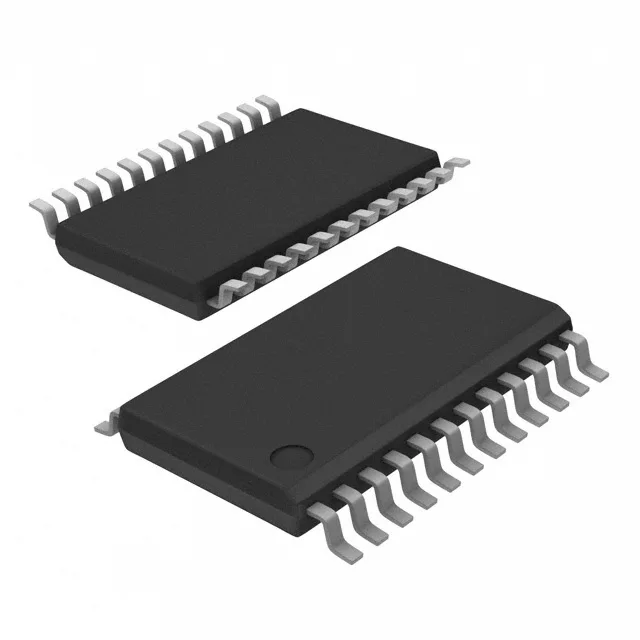
24-TSSOP with a 4.40 mm body width and 0.65 mm pin pitch — the 24-TSSOP footprint is a standard JEDEC MO-153 variant, so the PCB land pattern is well established. The surface-mount package suits reflow assembly; the tube delivery means the parts arrive in anti-static tubes, not tape-and-reel, which is the typical format for prototype and low-volume builds. The junction temperature will sit higher than TA under load; the thermal resistance of the TSSOP package (approximately 90 °C/W θJA on a standard 2-layer board) means the internal power dissipation should be checked against the die temperature limit, which is typically 125 °C for this process.
The part is ROHS3 compliant (EU 2015/863), which covers the full ten restricted substances including the four phthalates. Sourced through independent distribution against an RFQ — the active status means the factory continues to manufacture, so lead times are typically quoted in weeks, not months. The tube quantity (typically 60 per tube for 24-TSSOP) is the standard shipping unit; volume orders are handled per the BOM quantity.