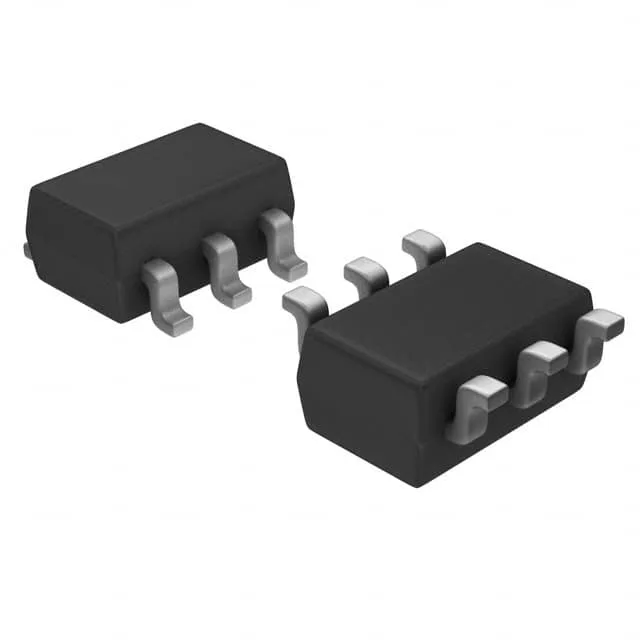
4.65V supervisor for a 5V rail — the threshold that decides the reset
The TPS3808G50QDBVRQ1: That threshold is set internally for the 'G50' variant — no external resistor divider needed — and targets a nominal 5V rail where the supervisor must hold the system in reset until the supply is stable. The open-drain active-low output lets the reset signal pull down to whatever logic rail the downstream MCU or FPGA uses, provided an external pull-up resistor is fitted.
Automotive-grade qualification and temperature envelope
For a production BOM in an automotive ECU, the Q1 suffix in the order code is the flag that confirms the grade; the base TPS3808 family also has non-automotive variants, so the full order code matters when ordering.
Adjustable reset timeout — one capacitor sets the delay
The reset timeout period is adjustable via a single capacitor connected to the CT pin. The designer picks the hold-off time — typically a few milliseconds to several hundred milliseconds — that guarantees the downstream processor's supply and oscillator have settled before the reset is released. No programming interface or register write is needed; it is a purely analog delay that stays set across power cycles. A fixed-time variant exists in the TPS3808 family, but the 'G50' with adjustable timeout gives the BOM flexibility to tune the delay without a PCB spin.
SOT-23-6 footprint — what the layout needs
The supplier device package is SOT-23-6, a 6-pin surface-mount package. The open-drain output needs a pull-up resistor to the reset rail.
Active production — no LTB shadow on the BOM
For a production line that already qualifies this supervisor, the risk of a forced respin due to obsolescence is low. The base product number TPS3808 covers a range of voltage threshold options and fixed/adjustable timeout variants, so if a future design moves to a different rail voltage, the footprint-compatible sibling can be specified without a board layout change.