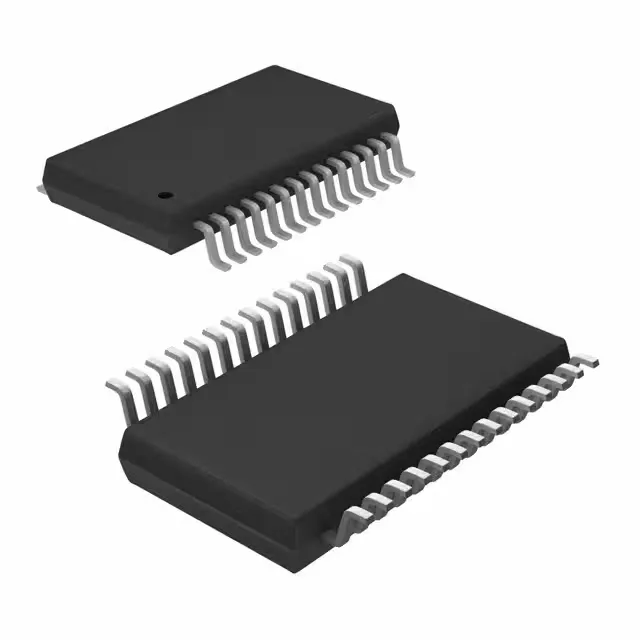
PCMCIA slot power switch — four outputs, three supply rails
The Texas Instruments TPS2205IDB is a dedicated PCMCIA power-interface switch that routes 3.3 V, 5 V, or 12 V to up to four card-slot outputs from a 3:4 input-to-output ratio. Each output is a high-side switch rated for 1 A continuous with a typical on-resistance of 103 mOhm, keeping conduction loss low enough that the 30-SSOP package handles the thermal load without a heatsink in most designs. The parallel interface accepts slot-select and Vcc/Vpp control signals directly from a system controller or PCMCIA host adapter — no serial bus overhead, which simplifies the firmware and reduces latency on card insertion events.
103 mOhm Rds(on) and the 1 A output ceiling
At 1 A per channel, the 103 mOhm typical Rds(on) produces about 103 mW of self-heating per active output. With all four channels loaded, the total dissipation sits near 0.4 W — within the 30-SSOP's capability in still air at 85°C ambient, but a layout with copper pours under the package helps keep junction temperature below the 125°C absolute maximum. The fixed current-limiting and over-temperature fault protection clamp the output before the die overheats or the card draws more than the 1 A ceiling. A status flag output reports fault conditions back to the host controller — useful for diagnostic logging or for sequencing a card power-down.
The 30-SSOP package (5.30 mm body width, 0.65 mm pitch) is a common footprint — the same land pattern used by many TI power-switch and interface parts, which helps consolidate stencils. The supply voltage (Vcc/Vdd) is not required — the switch derives its internal bias from the load rails, so no separate logic supply is needed.