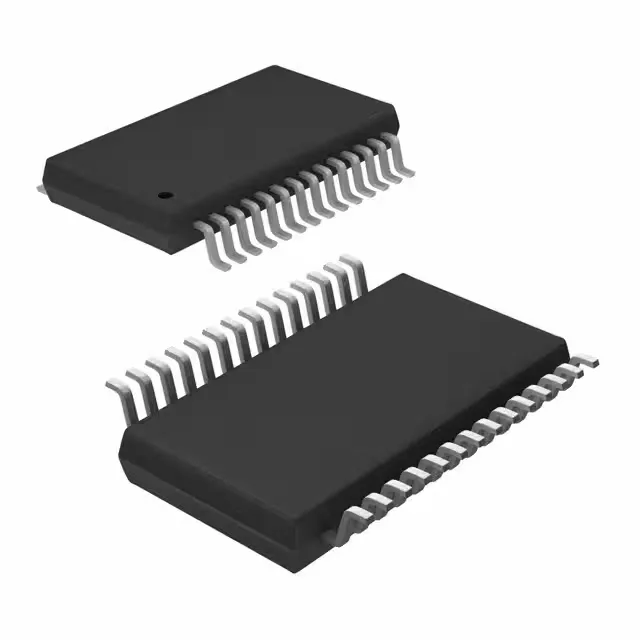
The Texas Instruments TPS2202IDFR is a four-output high-side PCMCIA power switch designed to distribute 3.3V, 5V, and 12V rails to PCMCIA/CardBus slots in laptop, embedded, and industrial computing systems. Each of the four outputs is rated for 1A continuous and is protected by fixed current limiting and over-temperature shutdown, with a serial interface controlling the output configuration in a 3:4 input-to-output ratio. The switch integrates Power Good and Status Flag outputs for monitoring rail integrity and fault conditions — useful for hot-swap sequencing where the host controller needs to verify the slot power before enabling the card bus.
160 mOhm Rds(on) and the 1A current ceiling
The 160 mOhm maximum on-resistance per channel sets the conduction loss floor — at 1A load the dissipation is 160 mW per channel, which sums to 640 mW worst-case across all four outputs and must be accounted for in the 30-SSOP package's thermal budget. The 1A per-channel current limit is fixed and non-adjustable — designs drawing above 1A per slot will trip the current-limiting protection, so the TPS2202IDFR is sized for standard PCMCIA Type I/II cards, not high-power CardBus peripherals that may exceed this ceiling.
The 30-SSOP package (0.209-inch body width, 5.30 mm height) and surface-mount footprint are standard for this family — any replacement candidate must match the same SSOP-30 land pattern and the 4.75V to 5.25V Vcc supply rail.
Temperature grade and operating envelope
The 4.75V to 5.25V Vcc supply rail powers the internal control logic and serial interface; the load-side voltages (3.3V, 5V, 12V) are supplied externally through the switch outputs.