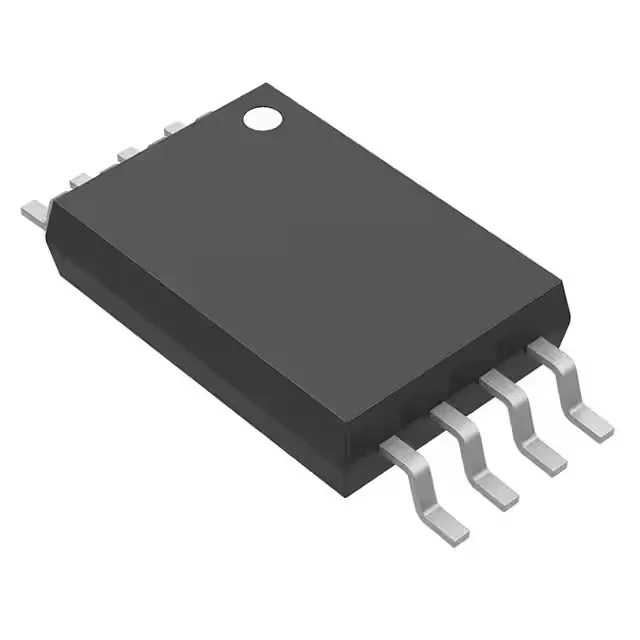
Dual-input power-path switch for handheld BOMs
The Texas Instruments TPS2113APW is a source selector switch — a 2:1 multiplexer for power rails that picks between two input supplies (e.g. USB VBUS and a Li-Ion battery) and routes the selected source to a single output. The N-Channel internal switches handle up to 1.25 A continuous, covering the current budget of a typical handheld or mobile device main rail. The 55 µA quiescent current keeps the battery drain low when the device is in standby or off.
Switching timing and load budget
Turn-on delay is 1 ms; turn-off takes 5 ms. That asymmetry matters when the switch transitions between sources: the 5 ms off-delay means the output rail stays live long enough for the downstream regulator input caps to hold up during the switchover, preventing a brown-out on the load. The 1.25 A current ceiling is the absolute maximum the internal FETs can pass. For production designs, derate by 20–30 % depending on ambient temperature and PCB copper area under the 8-TSSOP package — the 4.40 mm-wide body limits thermal dissipation compared to a larger SOIC footprint.
That qualifies the part for outdoor handheld terminals, factory-floor mobile scanners, automotive cabin electronics, and any battery-powered device that sees seasonal temperature swings or direct sunlight. The 8-TSSOP package (0.173" body width, 4.40 mm) is a surface-mount footprint common to low-power analog and power-path ICs.
New designs can commit this part to the BOM without a bridge-buy or obsolescence contingency.