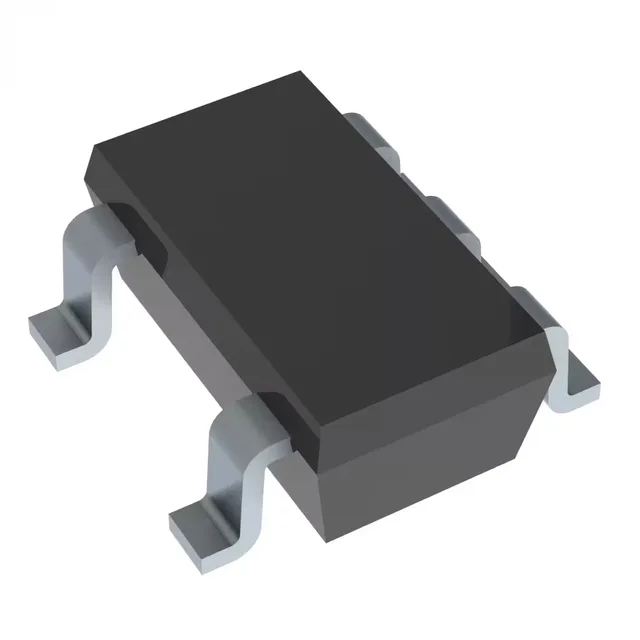
500 mA high-side switch with fault flag
The TPS2051BDBVT: It is a general-purpose switch, commonly used to power USB ports, peripheral loads, or point-of-load rails where a dedicated power-distribution switch beats a discrete MOSFET-plus-controller for BOM count and board space. Budget the hot Rds(on) into your IR drop calculation for the downstream rail.
Fault protection set and the status flag
Three built-in protections — fixed current limiting, over-temperature shutdown, and undervoltage lockout (UVLO) — mean the switch survives a shorted load or a hot board without external sense resistors or a supervisory IC. The current limit is fixed (not adjustable), so the load must stay within the 500 mA continuous ceiling; the part will fold back under overload, not latch off. A status-flag output (open-drain, active low) asserts when the switch is in a fault condition — current limit or thermal shutdown. This lets the system MCU detect a fault without polling the output voltage. The flag is valid only when the switch is enabled, so tie the enable pin to a GPIO, not VIN, to get fault reporting. The switch is non-inverting with a 1:1 input-to-output ratio — enable high turns the output on. No external Vcc supply is needed; the switch is self-powered from the load voltage pin.
Package, temperature grade, and board integration
Housed in a SOT-23-5 (SC-74A) package, the TPS2051BDBVT occupies roughly 3 mm × 3 mm on the board.
The base product number is TPS2051, so future variants (different current limits or packages in the same family) share the same datasheet and application notes. ROHS3 compliant — no RoHS exemption expiry to track.