200 MHz C28x core — what it buys in a real-time loop
Its 200 MHz core clock delivers the instruction throughput needed for high-bandwidth control loops — think dual-motor servo drives, digital power conversion with 100+ kHz switching, or resolver-to-digital decoding without an external FPGA. The 512 KB of on-chip Flash and 66K x 16 RAM provide enough code and data space for a full real-time OS or a bare-metal state machine with multiple nested interrupt service routines.
Analog front-end integration: 24+12 ADC channels, 3 DAC outputs
With A/D converters offering 24 channels at 12-bit resolution and 12 channels at 16-bit resolution, plus three 12-bit D/A converters, this part can sample a dozen current-sense resistors, a handful of voltage feedback dividers, and a temperature sensor — all without external analog muxing. The 16-bit ADC channels are particularly useful for precision current regulation in servo drives or for monitoring battery-stack voltages in energy storage systems.
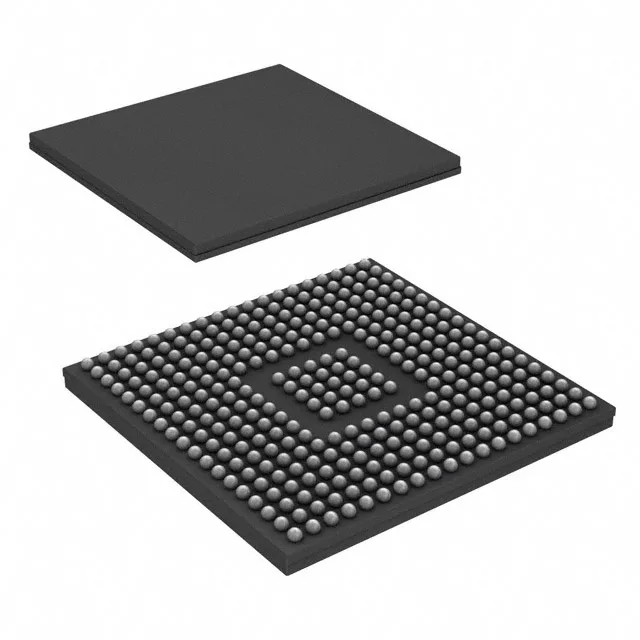
The 337-NFBGA (16x16 mm) package requires careful board-level thermal management — a solid via array under the center pad is recommended to pull heat into the ground plane.
Connectivity includes CANbus, I²C, SPI, SCI, UART/USART, USB, and a uPP (Universal Parallel Port) for high-speed data streaming to an external FPGA or ADC. The 169 I/O pins, DMA controller, PWM timers, and watchdog timer round out the peripheral set for a self-contained control board. An internal oscillator is available, though an external crystal or resonator is typical when tight timing accuracy is required.