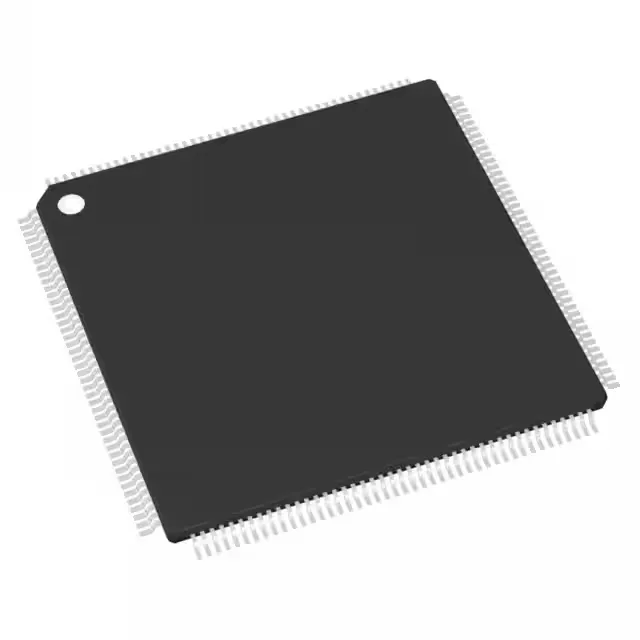
Texas Instruments TMS320F28235PTPS — Microcontrollers & Processors (MCU / MPU / DSP)

TMS320F28235PTPS C2000 Delfino MCU, 150 MHz, AEC-Q100

MPNTMS320F28235PTPS
Active

Texas Instruments Automotive, AEC-Q100, C2000 C28x Delfino series, 32-Bit Single-Core MCU, TMS320F28235PTPS, 150MHz, 512KB (256K x 16) FLASH, 34K x 16 RAM, 176-LQFP Exposed Pad, -40°C~125°C.

$30.9120Ref. price · indicative, final on quote
Independent supplier — new & surplus stockAuthenticity-screened · ESD-safe packingListing updated Jul 2026

Specifications

TMS320F28235PTPS specifications
ParameterValue
SeriesAutomotive, AEC-Q100, C2000™ C28x Delfino™
MountingSurface Mount
Oscillator typeInternal
Program memory typeFLASH
Voltage - supply (Vcc (Vdd))1.805V ~ 1.995V
Operating temperature-40°C~125°C(TA)
Speed150MHz
PackageTray
RAM size34K x 16
Core size32-Bit Single-Core
PeripheralsDMA, POR, PWM, WDT
ConnectivityCANbus, EBI/EMI, I²C, McBSP, SCI, SPI, UART/USART
Number of i (O)88
Core processorC28x
Case176-LQFP Exposed Pad
Data convertersA/D 16x12b
Program memory size512KB (256K x 16)

Product details

Active production, AEC-Q100 qualified — where is this part in the cycle?

For a shortage-desk buyer, that is the green light: no last-time-buy scramble, no forced broker channel. The AEC-Q100 qualification places it squarely in automotive and heavy industrial supply chains — the same qualification that keeps it on approved vendor lists for under-hood and chassis-domain ECUs.

150 MHz C28x core — what the speed rating buys you

The C28x core runs at 150 MHz, which is the headline number for this real-time control DSP. That clock rate, combined with the single-cycle MAC and hardware divide, lets it close a current-control loop in a few microseconds — think motor field-oriented control or digital power conversion where the PWM update rate hits 100 kHz or higher. If your algorithm fits in that footprint, the 150 MHz rating is the speed tier that keeps the loop jitter under a few hundred nanoseconds.

The supply range of 1.805 V to 1.995 V is a narrow core rail — a local LDO or a dedicated switcher is expected, not a shared 3.3 V bus.

With 88 GPIOs and connectivity that includes CAN, SPI, I²C, SCI, and McBSP, this part can handle a distributed control network — CAN for the vehicle backbone, SPI for local sensor clusters, and McBSP for codec or serial Flash. The 16-channel 12-bit ADC is the analog front end for current and voltage sensing; the PWM and QEP peripherals close the loop back to the power stage.

Frequently asked questions

Is TMS320F28235PTPS AEC-Q100 qualified?

Yes, the TMS320F28235PTPS is listed under the Automotive, AEC-Q100 series, confirming qualification for automotive-grade stress and reliability testing.

What is the speed of TMS320F28235PTPS?

The core operates at 150 MHz, which is the maximum clock frequency for the C28x CPU on this device.

What is the mounting type of TMS320F28235PTPS?

It is a surface-mount device in a 176-LQFP package with an exposed pad. The supplier device package is 176-HLQFP (24x24 mm).

How does TMS320F28235PTPS compare to TMS320F28335?

The TMS320F28335 is a higher-performance sibling with a floating-point unit (FPU) on the same C28x core, typically running at 150 MHz with larger memory options. The TMS320F28235PTPS is a fixed-point-only variant, which means it costs less but requires software scaling for fractional math. Both share the same 176-pin LQFP footprint and peripheral set, so a board designed for one can generally accept the other with a firmware change.

What is the core architecture of TMS320F28235PTPS?

It uses a 32-bit C28x core from the C2000 Delfino family, a single-core fixed-point DSP optimized for real-time control.