Its 100 MHz core clock directly sets the PWM update rate and ADC sampling window in motor-drive, digital power, and inverter applications — every nanosecond of interrupt latency matters when you are commutating a rotor or regulating a switching node. The 128 KB on-chip Flash holds the main control firmware plus a bootloader slot; the 18K x 16 RAM is sized for the lookup tables and state variables a typical field-oriented control (FOC) loop needs without external memory.
CANbus, PWM, and the peripheral set that decides the BOM
Integrated CAN 2.0B is the headline connectivity — this is the part you pick when the system communicates over a differential bus in an automotive or industrial network. Alongside CAN you get I²C, SCI, SPI, and UART/USART, covering sensor fusion, display links, and debug. The PWM and POR/WDT peripherals are hardwired for power-stage control; the 16-channel 12-bit ADC samples current and voltage feedback without an external converter. 35 general-purpose I/O is enough for a medium-complexity control board with a few limit switches, encoder inputs, and status LEDs.
Package and temperature — the rework-lab reality
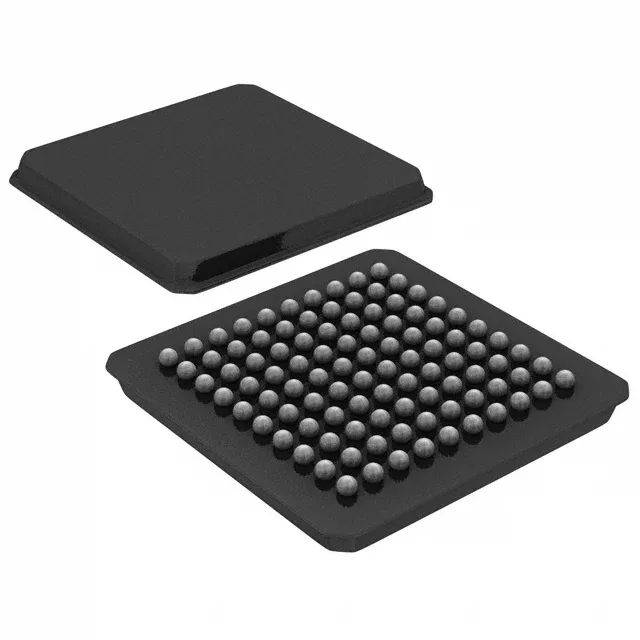
That is a fine-pitch BGA — not a QFP you can hand-solder with a standard iron. The rework profile needs a preheat soak at 125°C and a top-side hot-air nozzle matched to the 10 mm body; moisture sensitivity is MSL 3 out of the bag, so bake at 125°C for 48 hours if the seal has been open past the floor-life window.