90 MHz C28x core — real-time control headroom
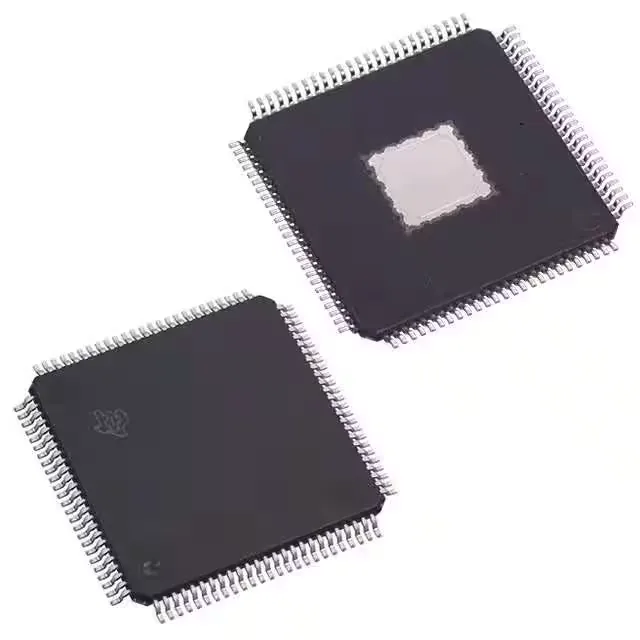
The single-core C28x architecture runs the control law directly in C or assembly with a hardware multiplier and atomic ALU, so the loop rate is set by the PWM update and ADC conversion, not by pipeline stalls. Program memory is 128 KB of Flash, paired with 50K x 16 of RAM — enough to hold a field-oriented control (FOC) kernel, a commutation table, and a modest data log without external memory. The 100-HTQFP package with exposed pad helps pull heat out of the die when the MCU is running the PWM peripherals and ADC at full rate in a sealed enclosure.
Peripheral set for motor-drive and industrial bus architectures
Connectivity includes CANbus, I²C, McBSP, SCI, SPI, UART/USART, and USB — the usual mix for a motor-drive control board that talks to a fieldbus gateway over CAN or Modbus, and to a host PC over USB during commissioning. The 16-channel 12-bit ADC samples current-sense resistors and rotor-position sensors; the 54 GPIO lines handle encoder inputs, relay drivers, and fault flags without an external CPLD. The PWM module is the critical one for motor-drive work — it generates the complementary gate signals with programmable dead-time that keeps the half-bridge from shooting through. The DMA offloads ADC result transfers so the core stays on the control law.
Supply rail and oscillator — no external clock needed
The 90 MHz core speed is achievable with the internal oscillator and the on-chip PLL, though flash wait states need to be set correctly in the boot code.
There is no official successor part published; the F2806x family remains the current-generation Piccolo offering for this performance tier.