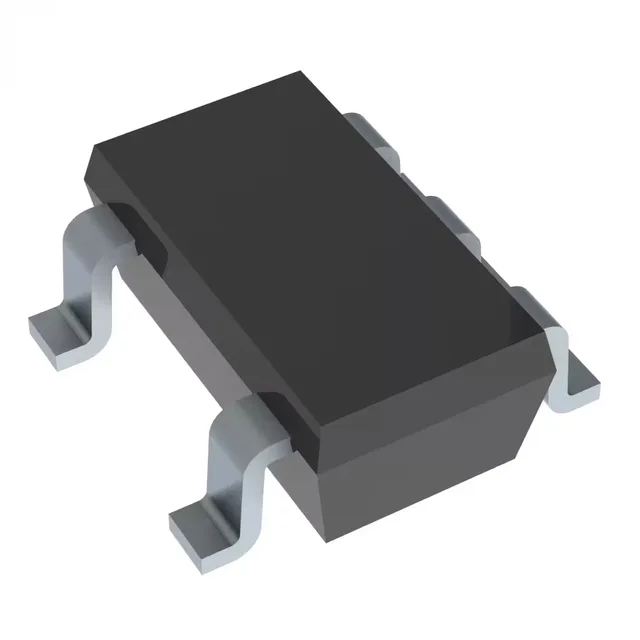
6 kHz GBW, 450 nA supply — the bandwidth-versus-power tradeoff
The TLV8801DBVT is a single-circuit general-purpose operational amplifier from Texas Instruments, specified for a gain-bandwidth product of 6 kHz and a supply current of 450 nA. The 6 kHz GBW sets the maximum frequency at which the amplifier maintains its open-loop gain — above this, the gain rolls off at 20 dB/decade. For a closed-loop gain of 10, the usable signal bandwidth is roughly 600 Hz, which suits DC or low-frequency sensor conditioning (thermocouple, strain gauge, photodiode) rather than audio or switching applications. The 450 nA quiescent current makes this part a candidate for battery-powered or energy-harvesting circuits where every microamp is budgeted. The rail-to-rail output stage allows the output to swing within millivolts of either supply rail, preserving dynamic range in a 1.7 V to 5.5 V single-supply system.
Input bias and offset — sensor front-end fit
Input bias current is 0.1 pA typical, which is negligible for most high-impedance sources. A 10 MΩ source resistance produces only 1 µV of offset error from bias current — well below the 550 µV input offset voltage. The offset voltage itself is the dominant DC error term; for a gain of 100, the output offset is 55 mV, which may require software calibration or AC coupling in precision applications. The slew rate is 0.0015 V/µs. This limits the large-signal bandwidth: at a 1 V output swing, the maximum frequency before slew-rate limiting is about 240 Hz. For pulse or step inputs, the output rise time into a 10 pF load is roughly 6.7 µs per volt.