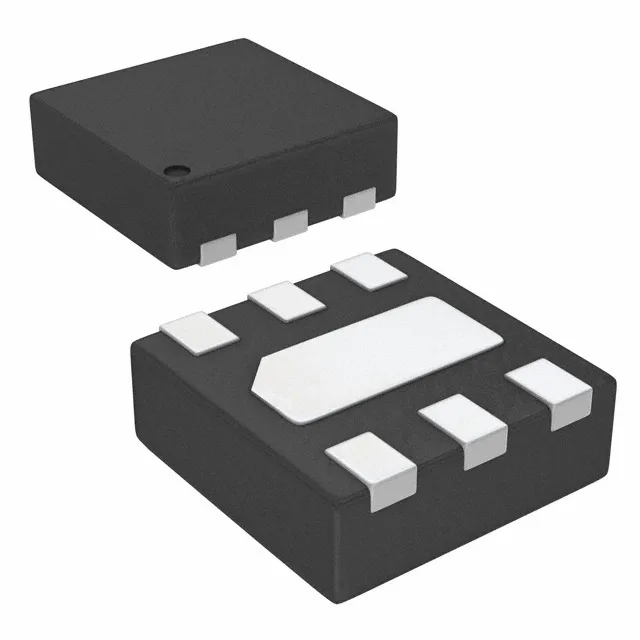
Dual fixed-rail LDO for noise-sensitive mixed-voltage designs
The TLV7163318PDPQR from Texas Instruments is a dual-channel LDO delivering fixed 3.3V and 1.8V outputs, each rated for 150 mA. This is a common rail pair for powering an MCU core at 1.8V and its analog or I/O supply at 3.3V from a single 5.5V max input rail. Quiescent current sits at 75 µA typical across both channels, which keeps the overhead low for battery-powered or always-on subsystems where the regulator stays enabled.
Power supply rejection ratio is specified at 80 dB at 100 Hz, rolling off to 46 dB at 10 kHz. That 80 dB at line frequency means the regulator attenuates 100/120 Hz ripple from a rectified input by a factor of 10,000 — useful when the upstream rail is a poorly filtered DC bus or a switching converter with high low-frequency ripple. The roll-off above a few kilohertz means the LDO's own bandwidth limits rejection of switching noise above 10 kHz; any fast transient noise from a buck converter upstream needs additional filtering or a post-regulator stage if the analog rail demands better than 46 dB rejection at those frequencies.
Dropout, quiescent, and the battery-life trade-off
Maximum dropout is 0.42 V at 150 mA on the 3.3V channel and 0.58 V at 150 mA on the 1.8V channel. For a 3.3V output, the input must stay above 3.72 V to maintain regulation at full load — a Li-ion battery near its 3.0 V cut-off is below that, so the regulator drops out and the output follows the input minus the pass element drop. The 75 µA quiescent current is the sum of both channels' operating current; in a battery-powered sensor waking once a minute to take a reading, that Iq dominates the sleep budget unless the regulator is disabled via the Enable pin between active periods.
Protection set and temperature range for industrial duty
Built-in protection covers over-current, over-temperature, reverse polarity, short-circuit, and under-voltage lockout (UVLO). The UVLO prevents the output from sourcing current when the input rail is too low to maintain regulation, which avoids brown-out behaviour on the downstream load. Operating junction temperature spans -40°C to 125°C, qualifying the part for automotive under-hood and industrial enclosure environments where ambient heat plus self-heating pushes the die above 85°C.
X2SON footprint and thermal pad layout
Surface-mount assembly with the 0.5 mm pitch X2SON footprint requires a solder stencil aperture that matches the pad dimensions in the TI recommended land pattern; the exposed pad's solder paste coverage should be around 50-70% to avoid voiding that lifts the die.