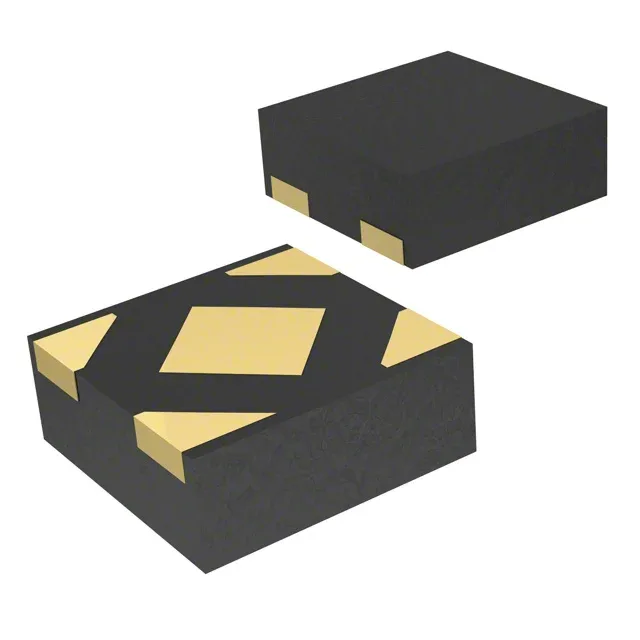
Fixed 2.5V rail from a 1×1 mm package
The TLV70725PDQNT: The 50 µA quiescent current is the current the regulator itself burns to stay alive — in a battery-powered sensor that spends most of its time in a light-load state, that Iq is the floor the system sees when the load is sleeping. The dropout voltage is 0.3 V max at 150 mA, which means the input rail needs to stay above 2.8 V to keep the output in regulation at that load. Below that headroom the output starts to track the input minus the dropout — the pass transistor enters its linear region and PSRR collapses.
PSRR profile — where the noise rejection lives
The PSRR is specified as 70 dB at 100 Hz, rolling off to 50 dB at 1 MHz. That 70 dB at line frequency means a 100 mV ripple on the input is attenuated to about 32 µV at the output — relevant for powering analog front-ends or ADC reference rails where the 50/60 Hz mains hum couples through the upstream supply. The 50 dB at 1 MHz is the band where switching regulators typically emit their fundamental ripple; the attenuation at that frequency is about 316×, so a 10 mV switching ripple becomes roughly 32 µV at the output. The protection set includes over-current, over-temperature, short-circuit, and reverse polarity — the reverse-polarity clamp means the regulator survives a reversed input without the output capacitor discharging back through the pass element. The enable pin (active high) lets a GPIO or supervisor IC shut the rail down, pulling Iq to near zero when the load is not needed.
Package and board-fit for the 4-X2SON
The junction-to-ambient thermal resistance depends on the board copper area; a 1×1 mm pad with a single via to an inner ground plane typically gives about 200 °C/W, so at 200 mA with a 1 V dropout (200 mW dissipation) the junction rise is about 40 °C above ambient.