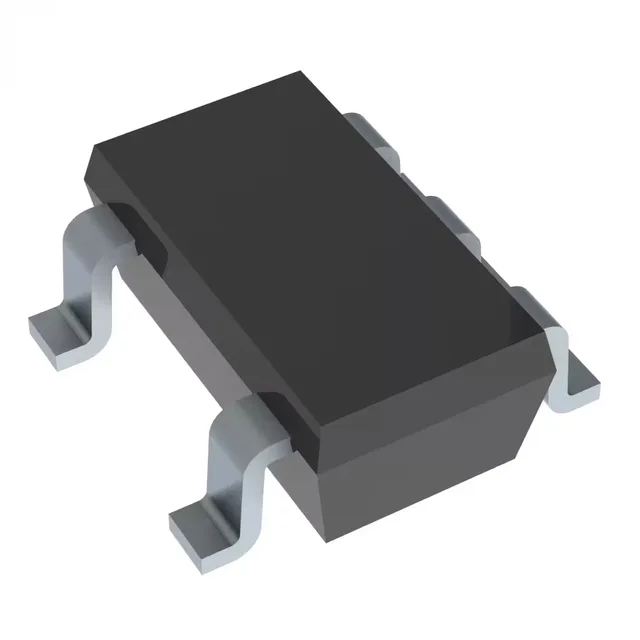
300 mA fixed 1.5 V LDO with 68 dB PSRR and 55 µA Iq
The TLV70215DBVR: The 55 µA quiescent current and 0.38 V max dropout at full load make it a candidate for always-on or battery-backed rails where the input-to-output headroom is tight — a 3.3 V bus feeding the 1.5 V rail leaves only 1.42 V for dropout plus IR drop, and the 0.38 V dropout fits comfortably.
PSRR and protection set for noise-sensitive rails
68 dB PSRR at 1 kHz means the LDO attenuates switching-regulator ripple on the input by a factor of ~2500 — a 10 mVpp ripple at 1 kHz becomes ~4 µVpp on the 1.5 V output. This is relevant for analog supply rails (ADC reference, op-amp Vcc) where the downstream PSRR of the load itself may be lower than the LDO's. The protection set covers over-current, over-temperature, reverse polarity, and under-voltage lockout (UVLO). The UVLO threshold prevents the output from sourcing current until the input rises above the minimum operating voltage, avoiding brown-out conditions on the load during power-up sequencing. Operating junction temperature spans -40 to 125 °C, covering the industrial temperature band and the lower end of automotive under-hood ambient. The 370 µA maximum supply current at no load sets a floor on the thermal dissipation in the SOT-23-5 package — at 125 °C ambient with a 5.5 V input and 300 mA load, the 1.2 W dissipation requires the board copper to act as the heatsink.
SOT-23-5 footprint and enable control
The TLV70215DBVR is supplied in a SOT-23-5 package (also described as SC-74A / SOT-753), a 5-pin surface-mount footprint with 0.95 mm pitch. The enable pin (active high) allows the rail to be sequenced or gated by a GPIO or power-good signal — the output ramps at the internal soft-start rate, limiting inrush into the load capacitance. The output is fixed at 1.5 V with ±2% accuracy over line, load, and temperature. No external resistor divider is needed; the feedback network is internal. The 300 mA rating is continuous — the part can deliver up to the current limit (typically 400 mA) during transients, but sustained operation above 300 mA triggers the over-current protection.