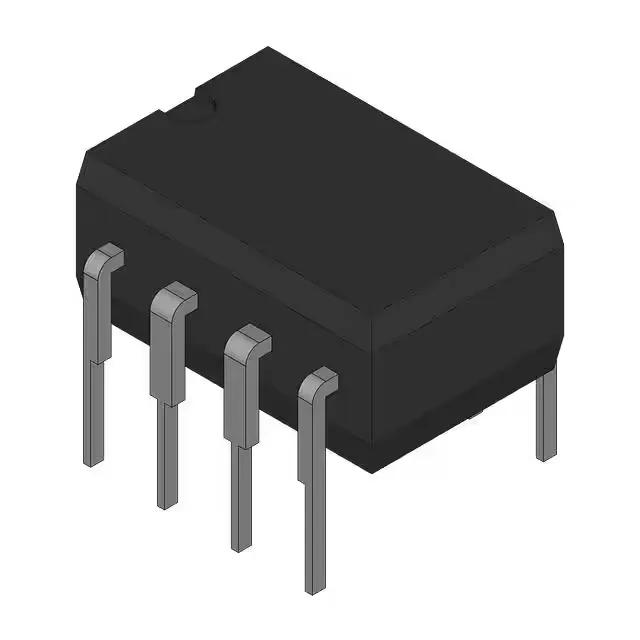
The TLE2141ACP: The 8-DIP (0.300", 7.62mm) through-hole package is rework-friendly: the leads are easy to inspect and hand-solder, and the part survives multiple hot-air cycles without lifting pads, unlike fine-pitch SMD packages.
Slew rate and bandwidth — the speed ceiling for signal conditioning
With a 45V/µs slew rate, this op-amp handles large-signal swings up to about 700 kHz before the output starts slewing — useful for fast-settling DAC buffers or waveform generation where the signal amplitude is several volts. The 5.9 MHz gain-bandwidth product sets the small-signal bandwidth: at a closed-loop gain of 10, the -3 dB bandwidth is roughly 590 kHz, adequate for audio, sensor conditioning, and control-loop filtering.
Supply flexibility and output drive — where this part fits
The 3.5 mA supply current is moderate — not ultra-low-power, but reasonable for a general-purpose amplifier in a multi-channel board where quiescent draw adds up.
DC precision and input characteristics — know the limits
Input offset voltage is 175 µV typical — adequate for 12-bit DC accuracy at gains under 100, but for microvolt-level signals you would want a zero-drift amplifier. Input bias current is 700 nA typical, from a bipolar input stage — this rules out high-impedance sources like photodiodes or pH probes unless you add a JFET buffer or use a much lower bias-current op-amp.
Temperature grade and compliance — what the part is certified for
ROHS3 compliant — no lead, mercury, cadmium, or other restricted substances in the package or plating.