2.25 MHz GBW, 3.6 V/µs — the signal-frequency ceiling
The TLC2272ACP is a dual CMOS operational amplifier from Texas Instruments, delivering 2.25 MHz gain-bandwidth product and 3.6 V/µs slew rate. For a closed-loop gain of 10, the small-signal bandwidth is roughly 225 kHz — sufficient for audio-band conditioning, sensor amplification, and control-loop filtering in industrial or instrumentation circuits.
Rail-to-rail output with 50 mA drive — no buffer needed
The rail-to-rail output stage swings within millivolts of the supply rails and sources or sinks 50 mA per channel. That drive capability lets the op-amp directly feed a successive-approximation ADC input, drive a cable capacitance, or bias a downstream transistor stage without an external buffer. Supply span runs from 4.4 V to 16 V single or dual supply — the 2.4 mA total quiescent current (both channels) keeps the power budget tight for a 5 V or 12 V rail in a multi-channel board.
1 pA input bias — the high-impedance front-end enabler
Input bias current is 1 pA typical, with a 300 µV maximum input offset voltage. For a 1 MΩ source impedance, the voltage error from bias current is 1 µV — negligible compared to the offset. This makes the TLC2272ACP a fit for photodiode preamps, pH probe buffers, or any sensor front-end where the source impedance is in the megohm range. The CMOS input stage keeps bias current low across the 0°C to 70°C commercial temperature range — no significant increase until above 85°C, which is outside this part's rated ambient.
8-DIP through-hole — prototype and low-volume BOM anchor
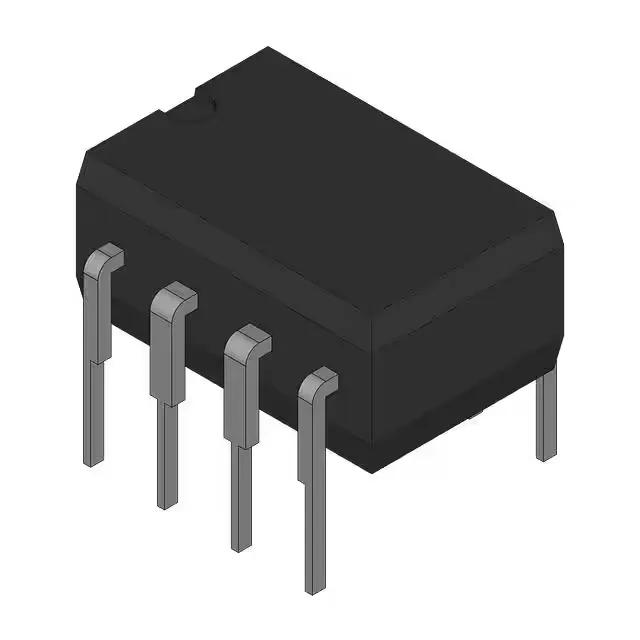
Housed in an 8-pin DIP (0.300-inch body, 7.62 mm width), the TLC2272ACP is socket-friendly and hand-solderable. The through-hole package suits breadboard prototyping, rework stations, and production runs where wave-solder or manual assembly is preferred over reflow. Supplied in tube — the standard DIP shipping format for pick-and-place tube feeders or manual kitting.