Quad LVDS driver for high-speed serial links
It integrates four independent driver channels, each capable of signaling at 630 Mbps, making it suitable for applications like flat-panel display interfaces, backplane interconnects, and camera serial links where low-voltage differential signaling reduces EMI and power consumption compared to single-ended alternatives.
630 Mbps per channel — what it buys the link budget
Each of the four drivers switches at 630 Mbps, which translates to a 315 MHz fundamental frequency in the differential signal. At this rate, the driver can support 24-bit color depth at WUXGA (1920×1200) resolution over a single LVDS link with four data lanes plus clock, or aggregate four independent lower-speed serial streams. The 630 Mbps figure is the maximum per-channel data rate; actual link margin depends on cable length, connector quality, and receiver jitter tolerance. For backplane applications, expect clean eye openings up to roughly 0.5 meters of standard LVDS cable at full rate.
If the design sees temperature excursions below freezing or above 70°C ambient, step up to the industrial-grade SN65LVDS391 variant.
3.3V supply rail — no level translation needed for common LVDS cores
The supply range of 3V to 3.6V centers on the standard 3.3V LVDS rail used by most FPGA banks, display timing controllers, and serializer-deserializer chips. If the upstream logic runs at 2.5V or 1.8V, the driver's LVTTL-compatible inputs may need external level shifters or series damping resistors to meet VIH thresholds. The 3.3V rail also sets the common-mode output voltage, so the receiver must accept a 1.2V nominal common-mode level.
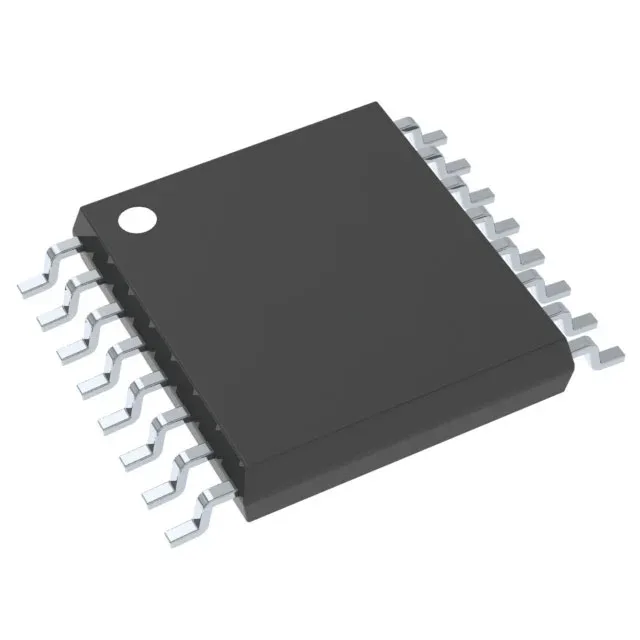
16-TSSOP — footprint and routing
Housed in a 16-lead TSSOP with 0.65 mm pitch and 4.4 mm body width, this package fits dense PCB layouts where board area is at a premium. The four differential output pairs (eight pins) route as controlled-impedance 100-Ω differential pairs; keep the pair-to-pair spacing at least three times the trace width to minimize crosstalk.
The part is RoHS-compliant and the 'G4' suffix indicates green (halogen-free) packaging. For dual-sourcing resilience, the SN75LVDS391PWR (without the G4 suffix) is the same silicon in the same package, differing only in the lead-finish material — both are active and interchangeable on the same PCB footprint.