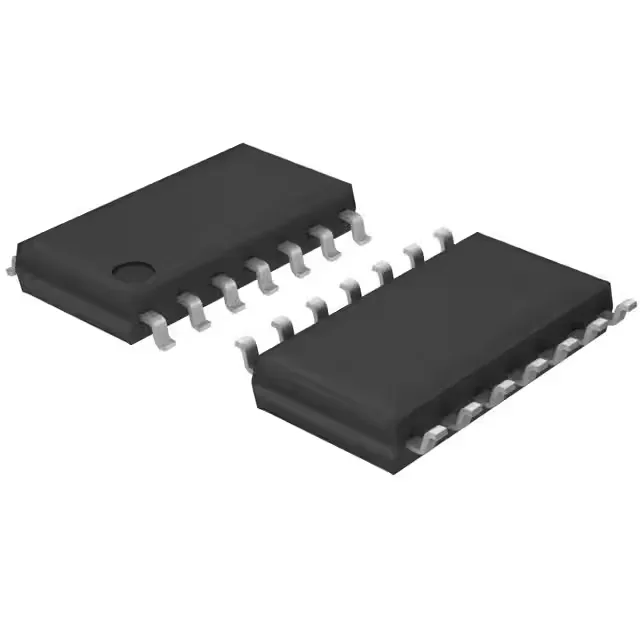
The SN74LVC86ANS: Four independent XOR gates in one 14-SOIC package — each gate takes two inputs and outputs a logic-high when the inputs differ. That makes it the go-to cell for parity generation, data comparison, controlled inversion, and clock-edge detection in digital signal paths.
Maximum propagation delay is 4.4 ns at 3.3 V with a 50 pF load. That is the worst-case number across temperature and voltage — the typical part is faster, but the 4.4 ns ceiling is what you budget for timing closure. At 2.5 V the delay stretches; at 1.8 V it is slower still. For a 100 MHz clock, one period is 10 ns — this gate adds under half a period of propagation, leaving room for setup and hold margins on the receiving flip-flop. Output drive is 24 mA both sink and source at 3.3 V. That is enough to drive a 50-ohm transmission line terminated to Vcc/2, or to fan out to a handful of CMOS inputs without a buffer. The 24 mA symmetric drive also keeps the rise and fall times balanced, which reduces duty-cycle distortion on the XOR output.
An engine-bay ECU that sees 105°C on a hot day still has 20°C of margin before the part leaves its guaranteed operating range. The 1 µA max quiescent current holds across temperature; standby power stays negligible even at 125°C. Input logic levels are specified as 0.1 V to 0.55 V for low and 1.45 V to 2.3 V for high — these are the guaranteed thresholds across the supply range. At 3.3 V, a 0.8 V low threshold and 2.0 V high threshold are typical for 3.3 V LVCMOS; the 74LVC inputs are 5 V tolerant, so a 3.3 V XOR can accept a 5 V logic signal without damage.
14-SOIC wide-body — rework-friendly footprint
The 14-SOIC package with 0.209-inch (5.30 mm) body width is the wide-body variant — the leads have more pitch and the body is easier to align under a hot-air nozzle than the narrow SOIC-14 (3.90 mm). Pin 1 is marked with a dot and a chamfer on the package body; the orientation is unambiguous under a microscope. The leads are gull-wing, so a standard fine-tip iron can touch each pin individually for touch-up. No hidden pads, no thermal pad underneath — this part lifts cleanly with hot air and tweezers. Supplied in tube — not tape-and-reel. That means the parts ship in anti-static tubes with the leads protected. For bench prototypes or small-batch rework, tube packaging is actually easier to handle than cut tape; you can slide one out without cutting a reel.
Active production, ROHS3 compliant
ROHS3 Compliant — the strictest EU RoHS classification, covering all ten restricted substances including the four phthalates (DEHP, BBP, DBP, DIBP). No exemption declarations needed; the part passes the full RoHS directive without carve-outs.