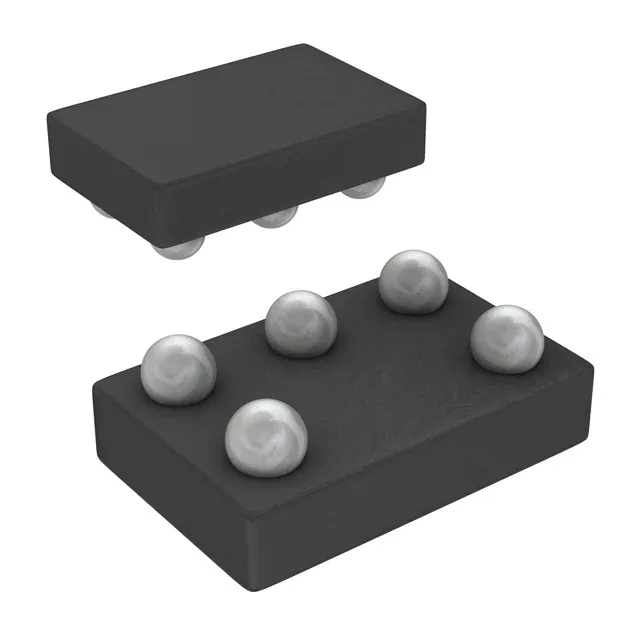
The SN74LVC1G240YEAR: The 3-state output allows bus-sharing applications. Output drive is 32mA for both high and low states.
For production programs still using this exact order code, the procurement strategy is to qualify a form-fit-function replacement or secure a last-time-buy quantity through independent distribution.
It allows the part to operate as a level shifter between low-voltage cores (1.8V) and legacy 5V peripherals, or as a simple inverting buffer in a 3.3V system. The wide range also means the same BOM line can be used across multiple voltage domains without changing the part number, simplifying procurement for multi-rail designs. The 32mA symmetric output drive is typical for the 74LVC family and provides enough current to drive a single LED, a relay coil through a transistor, or multiple CMOS inputs on a shared bus.
5-DSBGA package — the fit constraint
The 5-DSBGA (1.4x0.9 mm) package is an ultra-small wafer-level chip-scale package. It is the smallest footprint option for this function, which is an advantage for space-constrained designs like wearables, sensors, or compact modules. However, the tiny bump pitch and lack of visible leads make it difficult for hand-assembly, rework, or inspection. For prototyping or low-volume production, a larger-package alternative such as the SOT-23 or SC-70 variant of the same function is often preferred. The DSBGA package also requires careful PCB layout with micro-vias and a solder-mask-defined pad pattern.