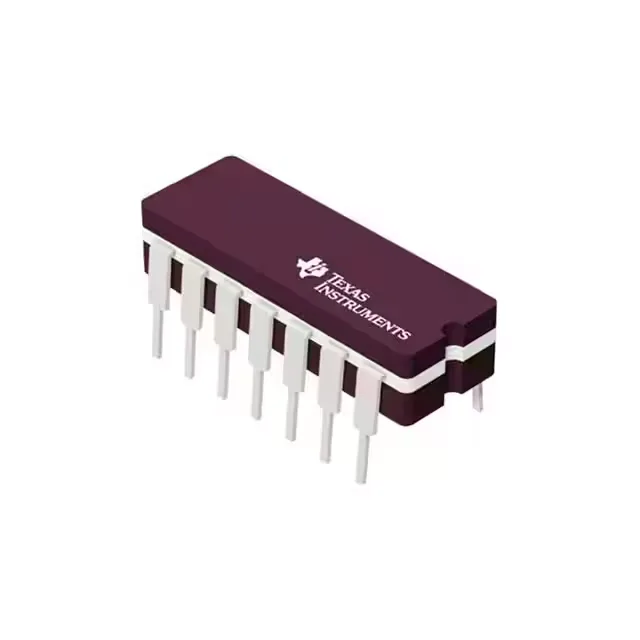
What this quad buffer does on the board
The Texas Instruments SN74HC126N packs four independent non-inverting buffers with 3-state outputs into a single 14-pin DIP. Each buffer passes the input to the output when its associated output-enable (OE) pin is high; when OE is low, the output goes high-impedance, letting multiple devices share a common bus line. The 74HC logic family runs on a 2V to 6V supply, so it mates directly with 3.3V or 5V logic without level translation. The through-hole 14-DIP package (0.300" body width) is a breadboard and prototype staple — easy to socket, easy to hand-solder, and simple to swap during debug.
3-state outputs and bus interfacing
The 3-state output is the feature that makes this part a bus buffer rather than a simple line driver. When OE is low, the output presents a high-impedance load to the bus — typically a few microamps of leakage — so another device can drive the same trace without contention. That is the standard arrangement for a shared data bus in a microcontroller system or a parallel interface between cards. The output current rating of 7.8 mA source and sink is typical for 74HC; it drives a standard TTL load or a few CMOS gate inputs, but not a long cable or a high-capacitance backplane trace without external buffering.