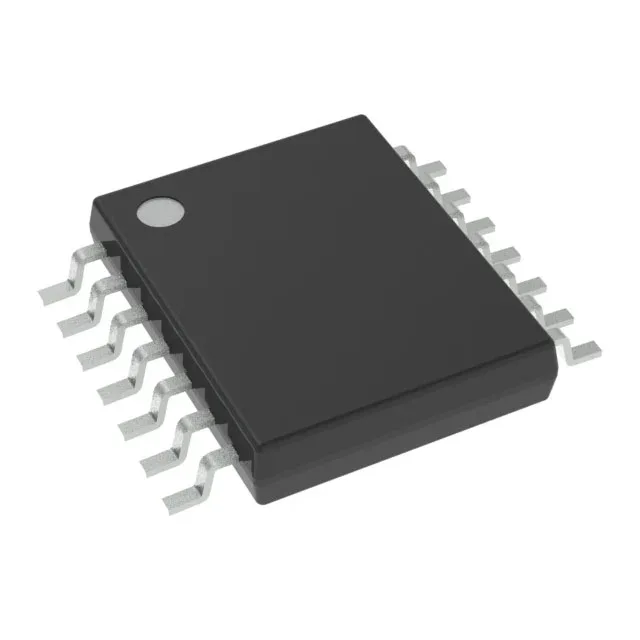
The SN74AC14PWR: That means no last-time-buy scramble and no forced redesign for the foreseeable future.
Schmitt-trigger inputs — why they matter on a noisy rail
Each of the six inverter channels includes a Schmitt-trigger input stage, which provides hysteresis between the low and high logic thresholds. For the 2 V to 6 V supply range, the low-level threshold sits between 0.5 V and 1.1 V, and the high-level threshold between 2.2 V and 3.9 V. That hysteresis cleans up slow edges and rejects noise on the input line — useful in industrial control panels, motor-drive feedback paths, or any board where long traces pick up coupled interference.
The 10 ns propagation delay at 5 V and 50 pF load keeps timing closure straightforward in most 10–20 MHz clocked systems.
The 14-TSSOP body (4.40 mm wide, 0.173″ pitch) is a fine-pitch but hand-reworkable package. Under hot air, the small thermal mass means the part lifts cleanly at about 300°C with good preheat on the board backside. Just watch the solder mask between pins — a no-clean flux pen and a fine tip clean up bridges quickly.
Where it fits — temperature and environment
The 74AC family's higher speed and lower power versus the 74HC series make it a natural choice for mixed 3.3 V/5 V boards where the logic needs to keep up with a fast microcontroller bus.