23 Mbps full-duplex RS-485 — what the data rate means for your bus
It handles 23 Mbps on the differential bus, which puts it in the fast tier for RS-485 — well beyond the 250 kbps to 10 Mbps range of typical industrial transceivers. At this rate the part suits high-throughput links like motor-drive feedback, multi-axis encoder networks, or daisy-chained sensor arrays where the bus must keep up with real-time control loops. Full-duplex operation means simultaneous transmit and receive over two twisted pairs — no direction-toggle overhead.
Supply rail and temperature range — where it sits on the board
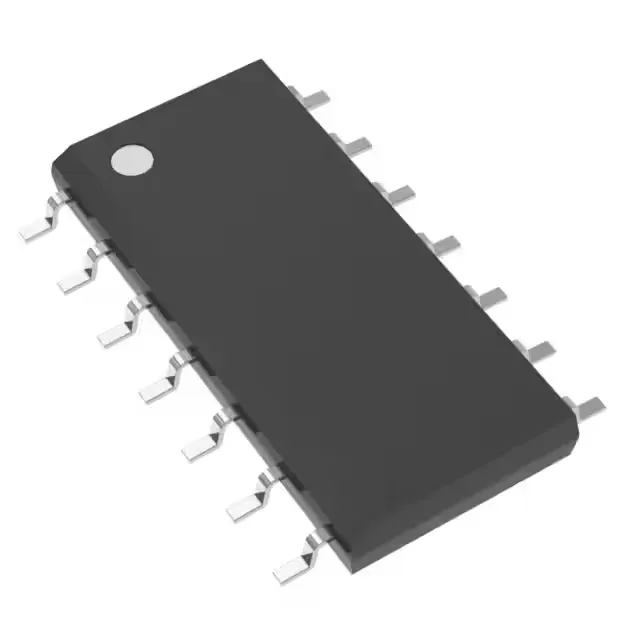
The 14-SOIC footprint is a common, rework-friendly package. No exposed pad to route, no thermal-via pattern to design — just the usual SOIC-14 land pattern and a 0.1 µF decoupling cap close to the supply pin.
TI lists the SN65HVD33DG4 as Active. For a BOM line this means the part stays in the supply channel for new-production builds without the date-code anxiety that comes with discontinued interface parts. The 14-SOIC variant (DG4 suffix) is the standard surface-mount option — no oddball reel or tray quantity to complicate procurement.