What this RS-485 transceiver does on the bus
The 50 mV of receiver hysteresis cleans up noise on long drops without external filtering.
Full duplex — why it changes the cable count
Most RS-485 transceivers are half-duplex, sharing a single twisted pair for transmit and receive with software-controlled direction. The SN65HVD1792DR is full duplex, meaning it uses two separate twisted pairs — one for transmit, one for receive — so the bus can send and receive simultaneously without toggling the driver enable. That matters if you are replacing an RS-422 link or building a point-to-point connection where latency matters and you do not want to manage direction in firmware. The trade-off: you need two pairs instead of one, but the wiring is simpler and the protocol overhead drops.
It is a current-production part available through independent distribution.
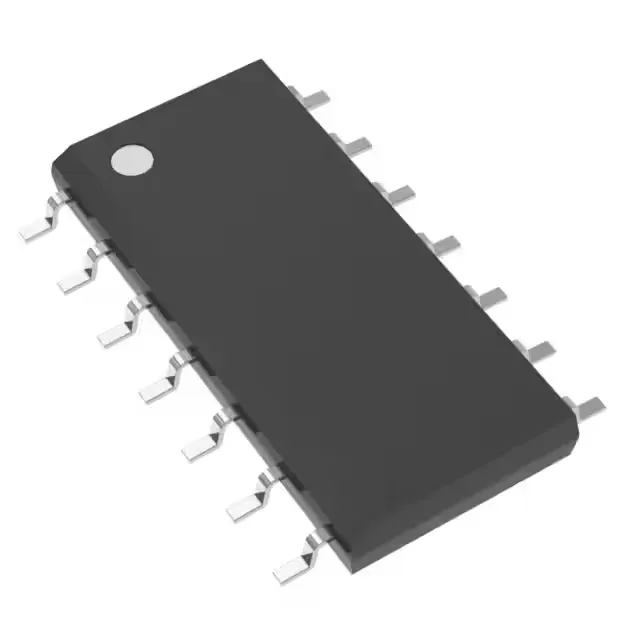
Package and footprint: 14-SOIC
The footprint is standard for this body size — no odd pad pitch or exposed pad to route. The tape-and-reel and cut-tape options cover both prototyping and volume reflow.