Quad micropower op-amp for battery and sensor front-ends
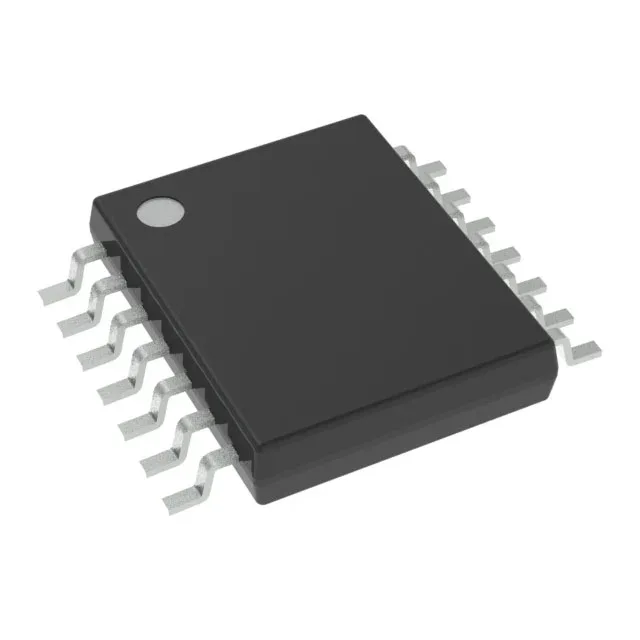
The OPA4347EA/250 from Texas Instruments is a quad-channel general-purpose operational amplifier in the microPOWER™ series, packing four independent op-amps into a 14-TSSOP package. Each channel draws just 20 µA of supply current, making the whole quad consume 80 µA — a fit for battery-powered instrumentation, portable medical devices, and sensor conditioning where every microamp counts. The 350 kHz gain-bandwidth product and 0.17 V/µs slew rate place it in the low-frequency signal-conditioning class — think thermocouple amplifiers, photodiode front-ends, and active filters below 50 kHz.
What the key ratings mean for your circuit
Rail-to-rail output swing means the output can reach within millivolts of both supply rails — useful when running from a 3.3 V or 5 V single supply and you need the full dynamic range into an ADC. Input bias current of 0.5 pA typ is low enough that a 10 MΩ source resistor causes only 5 µV of offset error — negligible for most precision sensor interfaces, though the 2 mV input offset voltage (Vos) is the dominant DC error term to budget. Operating temperature from -55°C to 125°C covers the full industrial and military-temperature range — the same quad can serve an engine-bay sensor module and a lab data logger without a grade change. Supply span from 2.3 V to 5.5 V means it runs directly from a single Li-Ion cell (3.0-4.2 V) or a regulated 3.3 V / 5 V rail — no extra LDO needed for the op-amp supply. Each output can source or sink 17 mA — enough to drive a reference input of a successive-approximation ADC or a small headphone load, but not a speaker or relay coil.
Package and assembly fit
The 14-TSSOP package (4.40 mm body width, 0.65 mm pin pitch) is hand-solderable with a fine-tip iron and magnification — no hot-air or reflow required for prototypes. Surface-mount mounting is standard; the 0.65 mm pitch is forgiving enough for a two-layer PCB with proper pad geometry.