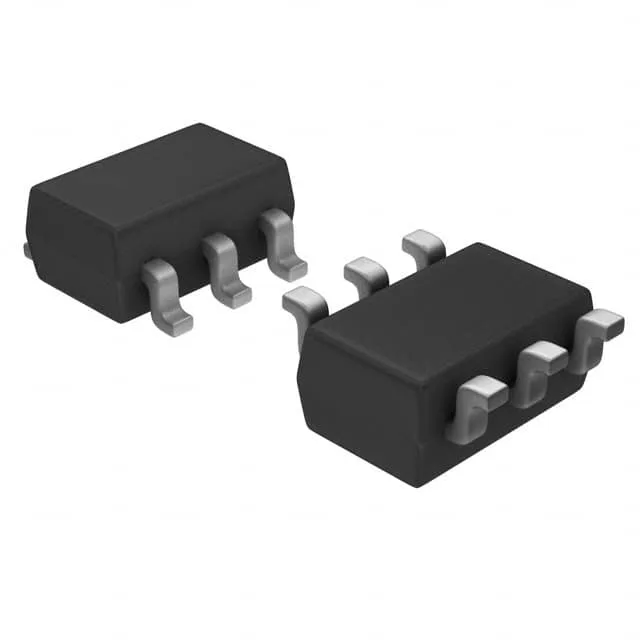
250 MHz bandwidth in a SOT-23-6 footprint
The OPA357AIDBVT is a single-channel voltage-feedback op-amp from Texas Instruments, packing a 250 MHz -3dB bandwidth and a 150 V/µs slew rate into a six-pin SOT-23 package. That combination means it can buffer a 10 MHz signal with less than 0.1 dB of gain peaking and still track a fast step without slewing — useful when the ADC driver or video line needs to settle to 0.1% inside 20 ns. The gain-bandwidth product is 100 MHz, so for a gain-of-10 stage the closed-loop bandwidth lands around 10 MHz. The 4.9 mA supply current per channel keeps the thermal budget low enough that the SOT-23-6 package doesn't need a copper pour for heat sinking in most signal-chain layouts.
Rail-to-rail output and input headroom
The rail-to-rail output stage swings within 50 mV of each supply rail with a 10 kΩ load, which means the ADC full-scale range isn't clipped. The input common-mode range extends 100 mV beyond the rails, so a ground-referenced sensor signal doesn't hit the input limit. Input bias current is 3 pA typical — low enough that a 1 MΩ source impedance drops only 3 µV of offset error. The 2 mV typical input offset voltage is the dominant DC error term; if the application needs sub-mV precision, a trim or auto-zero stage sits ahead of this part. Supply range spans 2.5 V to 5.5 V single supply, covering 3.3 V and 5 V rails common in mixed-signal systems. The 100 mA output current per channel can drive a 50 Ω back-terminated cable directly — no external buffer needed for video distribution.
Temperature grade and package fit
Rated for -40°C to 125°C operation, the OPA357AIDBVT covers the industrial temperature band and the lower end of automotive ambient. The SOT-23-6 package (supplier device package SOT-23-6) is a standard footprint shared by many pin-compatible op-amps — the board layout stays the same if a second-source or a different speed grade is needed later. Surface-mount assembly with MSL-1 floor life — no bake required before reflow if the sealed bag hasn't been opened. The small package means the feedback resistor and decoupling cap sit close to the pins, which keeps parasitic inductance low and preserves the 250 MHz bandwidth.