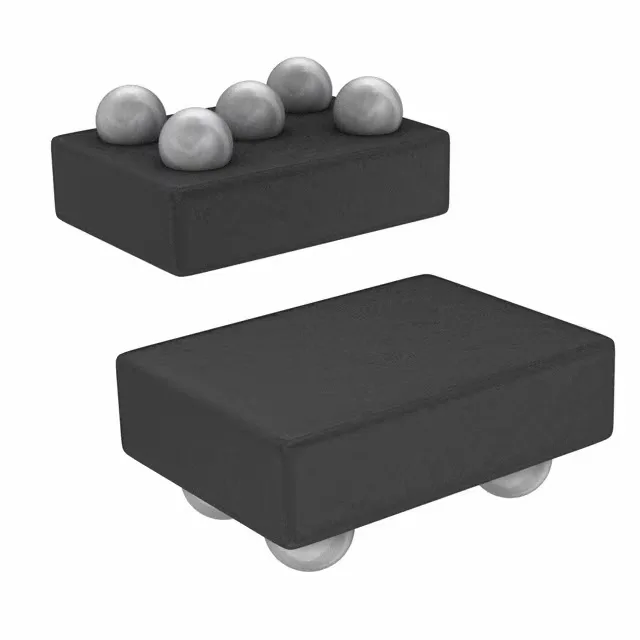
Date-code consistency and traceability to the original TI manufacturing lot should be verified on any material offered outside the authorized channel.
PSRR at 1 kHz — what 63 dB means for the analog rail
The PSRR is specified at 63 dB at 1 kHz, a typical ripple-rejection figure for a low-noise LDO in this current class. That level of rejection matters when the regulator powers a precision analog front-end — an ADC reference, an op-amp supply, or a VCO bias — where 1 kHz switching ripple from a downstream DC-DC converter would otherwise couple into the signal path. Below 50 mA output, the dropout voltage maxes at 0.22 V, keeping headroom loss tight on a 3.3 V rail.
Package and temperature grade — the 5-µSMD constraint
This is not a hand-solderable part; it requires a solder-paste stencil, a reflow profile matched to the µSMD's thermal mass, and X-ray inspection for voiding and ball wetting. The quiescent current sits at 95 µA, a reasonable figure for always-on or battery-backed rails.
The regulator integrates over-current, over-temperature, and short-circuit protection — standard for a modern LDO but worth noting for a design that cannot tolerate a latched fault on a 3.3 V analog rail. An Enable pin allows the rail to be gated by a system supervisor or GPIO, cutting the 95 µA quiescent draw when the load is idle.