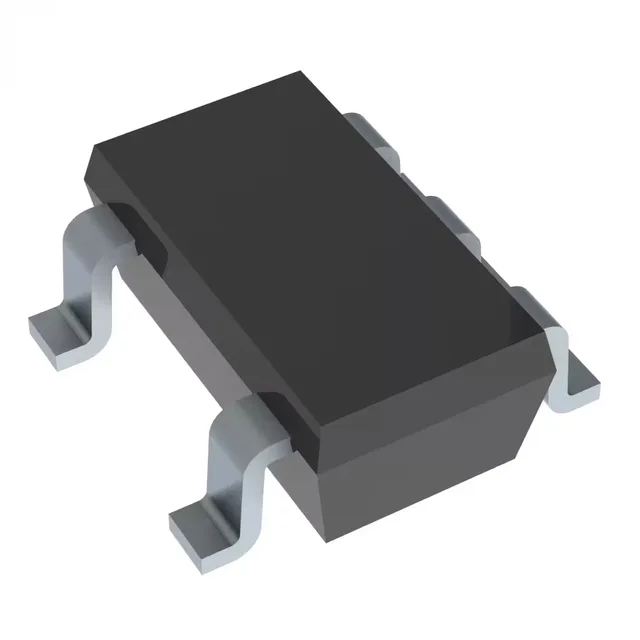
Fixed 4.7V rail in a SOT-23-5 footprint
The LP2980AIM5X-4.7 is a single-output positive LDO regulator from Texas Instruments that delivers a fixed 4.7V output at up to 50mA. The 4.7V rail is less common than 3.3V or 5.0V — it typically feeds analog front-ends, sensor bias circuits, or reference supplies that need a voltage between the standard logic rails.
Dropout and quiescent current — the battery budget
Maximum dropout voltage is 0.22V at the full 50mA load, so the input rail needs at least 4.92V to maintain regulation — a Li-ion cell near its end-of-discharge (3.0V) won't cut it; this part expects a 5V bus or a higher intermediate rail. Quiescent current is 95 µA typical, and the maximum supply current (including the output load) is 1.2 mA. For always-on circuits drawing microamps, the 95 µA Iq is noticeable — a lower-Iq LDO would stretch battery life, but the 1.2 mA ceiling keeps the thermal rise modest in the SOT-23-5 at full load.
PSRR at 1 kHz — audio-band ripple rejection
PSRR is specified at 63 dB at 1 kHz, which means the output attenuates a 1 kHz ripple on the input by a factor of roughly 1400. That's adequate for cleaning up switching-regulator feedthrough in the audio band, though the rejection rolls off above a few hundred kHz — a ceramic input cap with low ESL helps keep high-frequency noise from coupling through.
Texas Instruments no longer manufactures this fixed-voltage variant in production volumes. For a production line that needs this exact 4.7V rail, the independent channel is the practical path; for new designs, a currently-active LDO with a 4.7V fixed option or an adjustable-output sibling in the same footprint should be evaluated.
Protection and temperature range
Built-in protection covers over-current, over-temperature, and short-circuit events — the regulator folds back or shuts down before the die exceeds its safe junction temperature.