10 MHz GBW, 5.25 V/µs slew — the small-signal bandwidth ceiling
The LMV722MX is a dual-channel general-purpose op-amp from Texas Instruments with a 10 MHz gain-bandwidth product and a 5.25 V/µs slew rate. This combination sets the small-signal bandwidth ceiling at roughly 1.6 MHz for a gain of 10, and the large-signal output swing at 1 V peak-to-peak reaches about 800 kHz before slew-rate limiting begins. Operating from a single 2.2 V to 5.5 V supply rail, the rail-to-rail output stage swings within 50 mV of each supply — useful in single-supply 3.3 V or 5 V systems where headroom is tight.
DC precision and input characteristics
Input offset voltage is 80 µV typical, and input bias current is 260 nA. These figures are adequate for general-purpose signal conditioning — filtering, buffering, or non-inverting gain stages — but not for precision instrumentation front-ends where sub-µV offset or pA bias is required. Each channel draws 2.01 mA supply current, so the dual device consumes about 4 mA total. That is a moderate power budget — higher than a micropower op-amp, lower than a high-speed current-feedback type. Output current capability is 52.6 mA per channel, enough to drive a 100 Ω load to 5 V swing or to charge the sampling capacitor on a successive-approximation ADC input in one acquisition cycle.
Package, temperature grade, and compliance
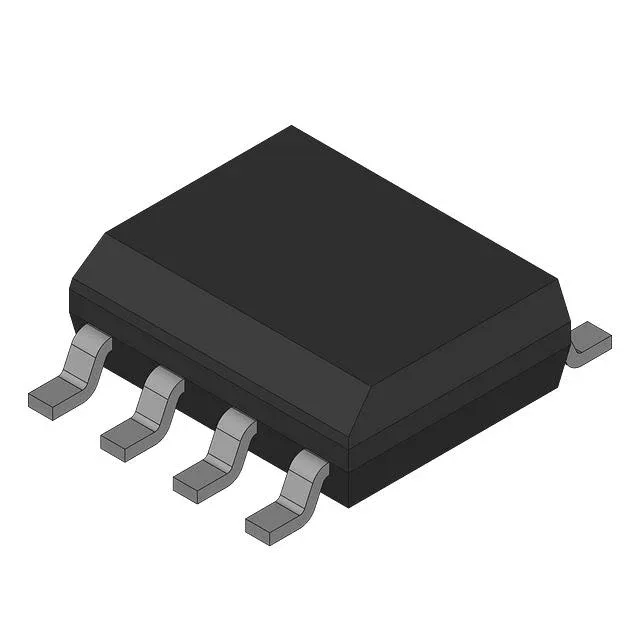
The LMV722MX is supplied in an 8-lead SOIC package (0.154-inch body width, 3.90 mm), a standard surface-mount footprint compatible with most automated assembly lines. The operating temperature range is -40°C to 85°C junction temperature, suitable for industrial and automotive cabin environments. Lifecycle status is Active per the manufacturer. The part is RoHS non-compliant — it uses leaded solder terminations, so it is best suited for legacy BOMs or applications with a RoHS exemption (e.g., military, aerospace, or high-reliability leaded solder processes).