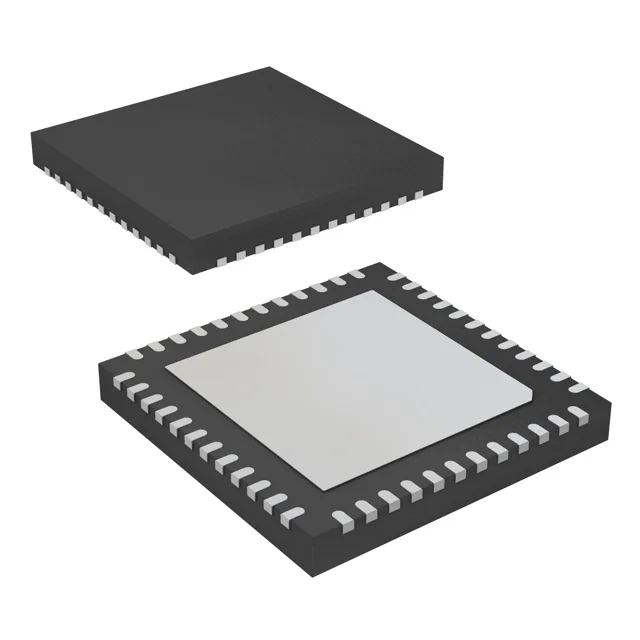
2:16 fanout at 2 GHz — the timing-tree workhorse
The LMK1D1216RGZT is a 2:16 differential clock buffer from Texas Instruments, built to distribute a single high-frequency reference to sixteen LVDS outputs without adding a full PLL's worth of jitter. The 2 GHz maximum frequency covers the common networking and instrumentation clock rates — 156.25 MHz, 312.5 MHz, 1.25 GHz — with margin for the fundamental. The 2:16 ratio means one input fans out to eight copies per bank, or two independent inputs each drive eight outputs. All signal paths are differential end-to-end, so the common-mode rejection holds up against ground bounce on a dense board.
Input flexibility and supply rails
The buffer accepts CML, HCSL, LVCMOS, LVDS, and LVPECL inputs — the AC-coupled termination network on the PCB selects the standard, not the silicon. The output format is fixed LVDS, which keeps the swing small and the edge rate controlled. The 48-VQFN (7x7 mm) package with exposed pad pulls heat into the PCB ground plane — the thermal vias under the pad are part of the thermal budget.
Active lifecycle and sourcing
No pin-compatible second source or official successor is published. The 2:16 fanout and 2 GHz bandwidth are the distinguishing parameters — a replacement search would need to match both the ratio and the differential signaling.