PLL clock conditioner with 2.16 GHz ceiling
The Texas Instruments LMK04033BISQX/NOPB is a PLL-based clock conditioner — it takes a reference input and generates multiple cleaned-up, frequency-synthesized output clocks. The 2.16 GHz maximum output frequency targets high-speed serial links: 10GbE, CPRI/OBSAI, JESD204B ADC/DAC reference clocks, and FPGA transceiver reference tiers. The 2:6 input-to-output ratio means you can feed one or two reference sources and get six conditioned clock outputs, each independently programmable in frequency and format. The divider/multiplier block (Yes/Yes) lets you synthesize frequencies that aren't integer multiples of the input — useful when the system needs a 156.25 MHz Ethernet clock from a 10 MHz TCXO.
Output format flexibility — one part, four logic families
Each of the six outputs can be independently set to LVCMOS, LVDS, 2VPECL, or LVPECL levels. That means a single LMK04033BISQX/NOPB can drive a 100 MHz LVCMOS clock to a FPGA fabric, a 312.5 MHz LVPECL clock to a SerDes reference, and a 1.25 GHz LVDS clock to a JESD204B ADC — all from one device. The differential input/output support (Yes/Yes) ensures the high-frequency paths maintain signal integrity over board traces.
The supply voltage is tight at 3.15 V to 3.45 V: the 3.3 V rail must be clean and within 5 % regulation; a noisy supply will push the PLL phase noise above the datasheet floor.
48-WQFN with exposed pad — thermal and layout notes
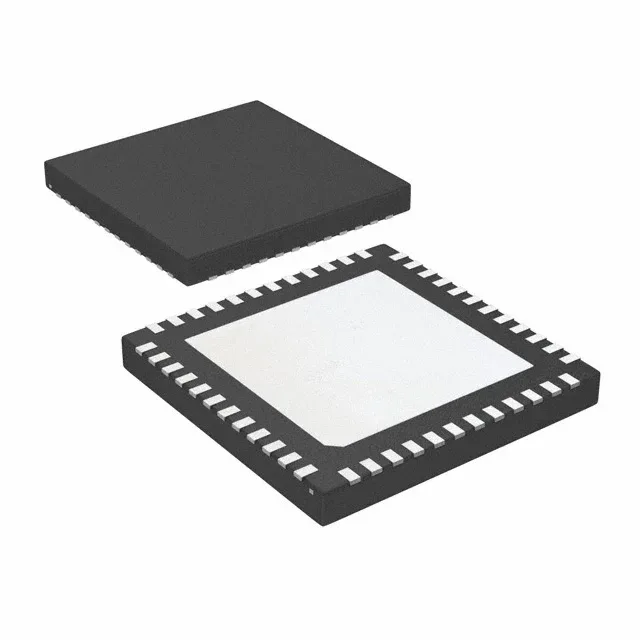
Housed in a 48-lead WQFN (7x7 mm) with an exposed pad.
This part can be designed into new production without worrying about obsolescence-driven respins. The base product number LMK04033 covers a family of clock conditioners; the /NOPB suffix confirms lead-free (RoHS) construction.