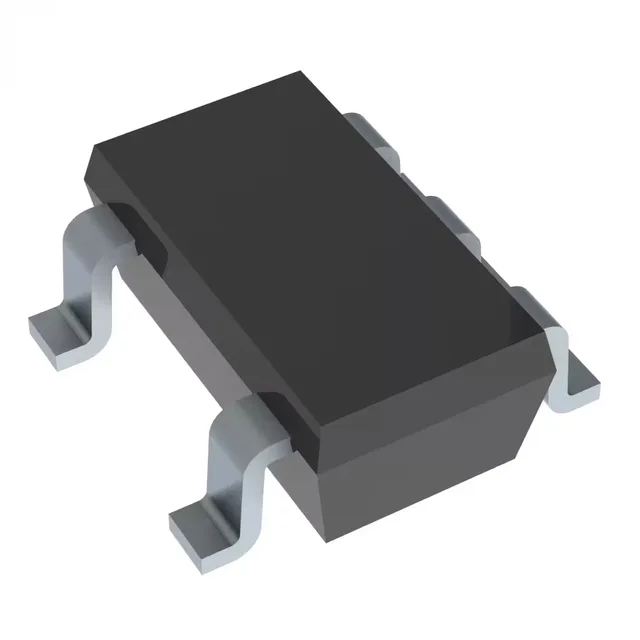
High-speed voltage feedback amplifier in a SOT-23-5
The 700 V/µs slew rate and 270 MHz -3 dB bandwidth suit it for video line drivers, ADC input buffers, and high-speed signal conditioning where settling time matters.
The 700 V/µs slew rate is the headline number that determines how fast the output can swing under a large-signal step. For a 5 V peak-to-peak output, that translates to roughly 7 ns rise time — fast enough to preserve pulse edges in a 10 MHz square wave or to settle a 12-bit ADC input within one clock cycle at 50 MSPS. The 270 MHz -3 dB bandwidth (small-signal) tells you the gain rolls off at 270 MHz; unity-gain stable, so you don't need external compensation. If your application is a video DAC buffer or a high-speed comparator driver, these two specs together define the usable frequency range.
The 12 V maximum opens up ±6 V dual-supply operation for analog front-ends that need a wider output swing. The 6.5 mA supply current per channel is reasonable for the speed class, keeping the thermal budget manageable in the SOT-23-5 package.
The suffix /NOPB confirms ROHS3 compliance — lead-free and fully RoHS compliant. No PCN or LTB has been issued for this part as of the current lifecycle record.