Package and integration story
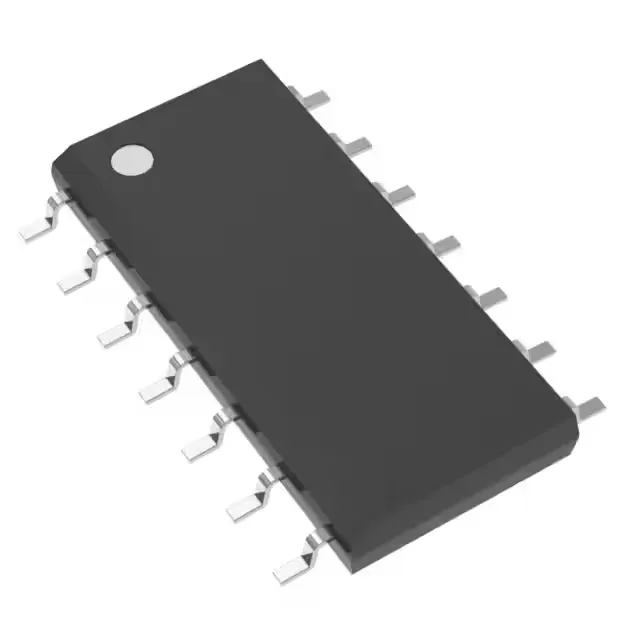
The LMH6644MA/NOPB is a quad voltage-feedback op-amp from Texas Instruments' LMH series, housed in a 14-SOIC package with a 3.90 mm body width. The surface-mount footprint demands a standard SOIC-14 land pattern; the 1.27 mm pitch is board-friendly for two-layer designs, but the 130 MHz bandwidth means the feedback loop and supply decoupling need careful placement to avoid parasitic oscillation. With four independent amplifiers in one package, this part saves board space in multi-channel signal conditioning — each channel draws 2.7 mA quiescent supply current, totalling 10.8 mA for the full device, which is modest for a 130-MHz amplifier.
Slew rate and bandwidth — what they mean for signal fidelity
The 135 V/µs slew rate means the output can swing from rail to rail in under 0.1 µs for a 10 V step — this is fast enough to reproduce a 10 MHz square wave with minimal slew-induced distortion. The 130 MHz -3 dB bandwidth sets the small-signal gain ceiling: at a gain of 10, the closed-loop bandwidth drops to roughly 13 MHz, which still covers high-speed ADC driver or video buffer applications. Rail-to-rail output swing means the output can reach within millivolts of both supply rails — critical for single-supply designs where headroom is tight, such as 3.3 V or 5 V systems. The 75 mA output current per channel can drive 50-ohm loads directly, though the thermal rise in the 14-SOIC package should be checked for continuous high-current outputs.
Supply rails and temperature grade — fit for industrial signal chains
The supply span from 2.7 V to 12.8 V covers both 3.3 V and 5 V logic rails as well as ±5 V split supplies. The -40°C to 85°C operating temperature range qualifies it for industrial environments — factory-floor sensor interfaces, motor-drive feedback, or outdoor telecom equipment that sees seasonal extremes. Input offset voltage is 1 mV typical and input bias current is 1.6 µA — these are moderate values for a high-speed amplifier. For precision DC applications below 0.1% accuracy, the offset may need trimming or a chopper-stabilized alternative; for AC-coupled or high-frequency paths, these specs are well within budget.