0.002 pA input bias — the sensor front-end enabler
The LMC6042IN/NOPB: Input bias current of 0.002 pA typ means the op-amp's own input stage draws essentially no current from the signal source. For a photodiode transimpedance amplifier with a 10 MΩ feedback resistor, that bias translates to 20 µV of offset error — negligible compared to the 1 mV input offset voltage itself. This lets the LMC6042 interface directly with high-impedance sensors without a separate buffer stage. The CMOS amplifier topology combined with rail-to-rail output means the output swings within 10–50 mV of either supply rail. In a single-supply 5 V system, the usable output range is nearly 0 V to 4.95 V — no headroom loss at the top or bottom of the signal swing.
26 µA per channel — the power budget fit
Supply current is 26 µA per amplifier, so the dual-channel device draws 52 µA quiescent total. In a battery-powered data logger sampling one sensor every 10 seconds, the op-amp's contribution to the sleep-mode current is lower than the microcontroller's RTC draw. The 4.5 V to 15.5 V supply span means it runs from a single lithium cell through a boost regulator, or directly from an unregulated 12 V industrial rail without a secondary LDO. Output drive capability of 40 mA per channel is enough to charge the sample-and-hold capacitor of a 12-bit SAR ADC in under 1 µs, or to drive a small indicator LED through a current-limiting resistor without a separate transistor.
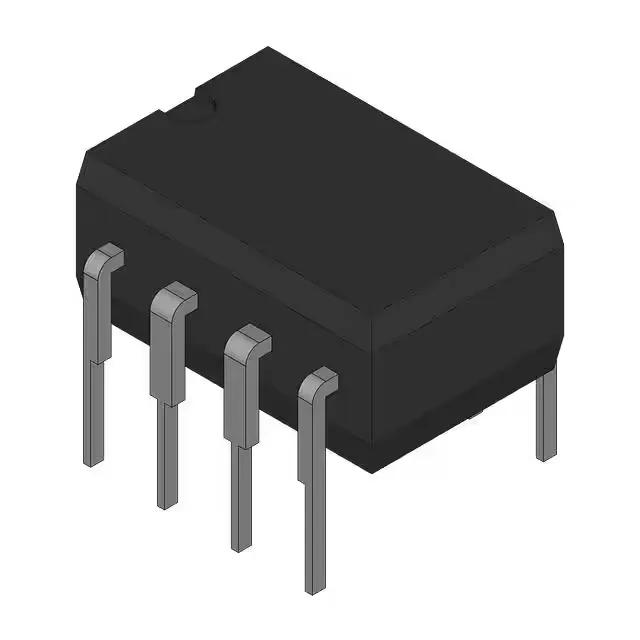
8-DIP through-hole — breadboard and low-volume fit
The 8-DIP package (0.300" width, 7.62 mm pitch) is the standard through-hole format that fits breadboards, prototyping boards, and socketed production. No reflow profile needed — hand-solder or wave-solder.
100 kHz gain-bandwidth — speed ceiling for precision
Gain-bandwidth product is 100 kHz. At a closed-loop gain of 10, the -3 dB bandwidth is 10 kHz — adequate for 1 kHz sensor signals with 10× margin. The 0.02 V/µs slew rate limits the large-signal response: a 5 V peak-to-peak output step slews in 250 µs, so the full-power bandwidth is roughly 3.2 kHz. This is not a fast amplifier; it is a precision amplifier for DC and low-frequency AC signals where noise and drift matter more than speed.