Micropower op-amp for precision, low-frequency signal chains
The LMC6041IN/NOPB: It draws just 18 µA supply current, placing it in the micropower class — suited for battery-powered or energy-harvesting sensor interfaces where every microamp counts.
What the key ratings mean for your BOM
The 75 kHz gain-bandwidth product sets the usable frequency ceiling — for a gain-of-10 stage the closed-loop bandwidth is roughly 7.5 kHz, adequate for slow sensor signals (temperature, pressure, strain) but not audio or switching applications. Input bias current of 0.002 pA (2 fA typical) means the amplifier's own input current is negligible even with 10 MΩ source impedances — the voltage error from bias current flowing through the source resistor stays below 20 nV, preserving DC accuracy in high-impedance front-ends like photodiode amplifiers or pH probes. The 4.5 V to 15.5 V supply span means the same part works from a single lithium cell (4.5 V minimum) up to a dual ±7.5 V supply — no need to stock separate low-voltage and high-voltage op-amp variants for different rails on the same board. 1 mV maximum input offset voltage guarantees DC accuracy within 0.02 % of a 5 V full-scale reading without external trimming — adequate for 10- to 12-bit sensor acquisition without auto-zero calibration.
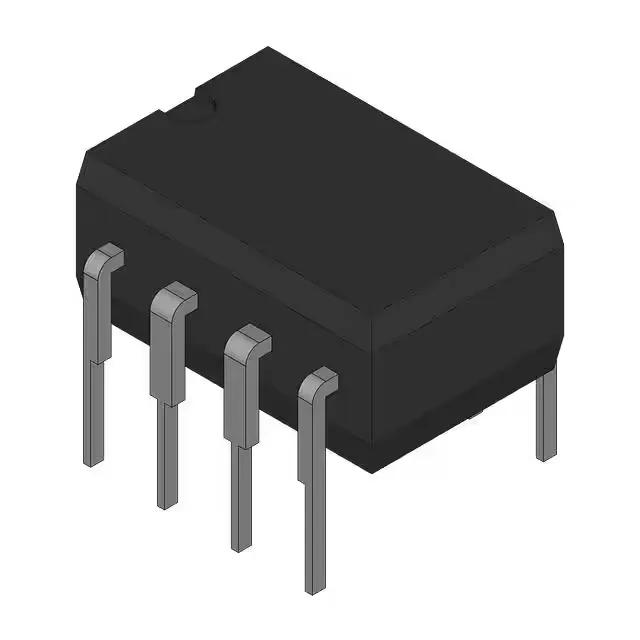
The 8-DIP (0.300-inch row spacing) package is breadboard- and prototype-friendly — it plugs directly into a solderless breadboard or standard 0.100-inch pitch perfboard. For production, the through-hole footprint requires a drilled PCB; no reflow profile needed. Supplied in tube packaging — the tube holds multiple devices with anti-static protection. For pick-and-place, a tube feeder or manual insertion is required; no tape-and-reel option is listed for this through-hole variant.
Lifecycle and compliance snapshot
ROHS3 compliant (exemption-free) — no restricted substances above the threshold limits, suitable for EU-market products without exemption expiry concerns.