Active production — still a design-in option
The LM2900N: ROHS3 compliance is confirmed, so it meets the latest EU restriction-of-hazardous-substances directive without requiring a waiver or exemption review.
Slew rate and bandwidth — what they mean for signal fidelity
With a 20V/µs slew rate, the LM2900N can swing its output rail-to-rail at frequencies up to roughly 300 kHz before the slew-induced distortion exceeds acceptable levels — useful for fast-settling analog front-ends or pulse amplification where edge rates matter. The 2.5 MHz gain-bandwidth product sets the usable closed-loop bandwidth: at a gain of 10, the -3 dB point lands around 250 kHz, which covers most sensor conditioning, audio, and control-loop applications.
Supply range and power budget for multi-channel boards
The supply span runs from 4.4 V minimum to 32 V maximum, so the same part works on a 5 V logic rail, a 12 V industrial bus, or a ±15 V split supply — no need to qualify different op-amp variants for different board voltages. Total quiescent current for all four amplifiers is 6.2 mA typical, or about 1.55 mA per channel — low enough that a 24 V supply feeding a 4-channel filter bank dissipates under 150 mW in the op-amp itself. Each output can source or sink 18 mA, enough to drive a 2 kΩ load to within a volt of the rails or to charge a 100 pF sampling capacitor in under 10 ns.
Package and temperature — breadboard to production
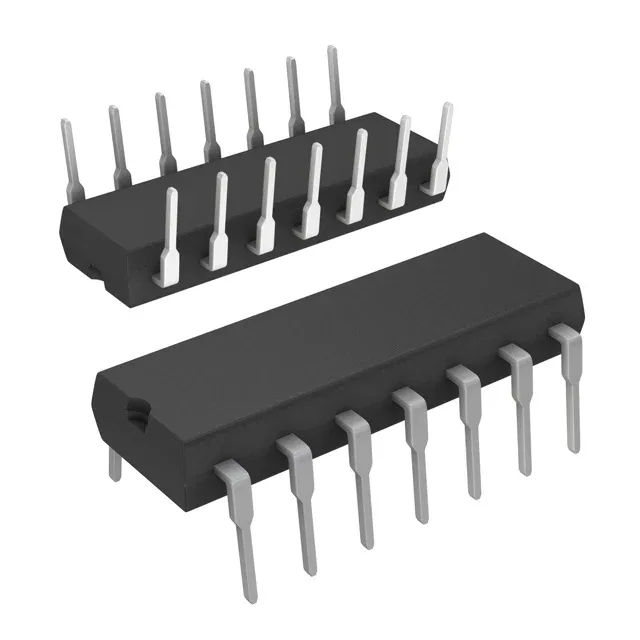
Housed in a 14-pin DIP with 0.300-inch row spacing (14-DIP, 7.62 mm body width), the LM2900N fits standard breadboards and through-hole prototyping sockets, and the 14-PDIP supplier package designation means the same footprint serves both TI and second-source parts. The -40°C to +85°C industrial temperature range covers most factory-floor, outdoor telecom, and automotive-cabin environments without needing a more expensive extended-range part.