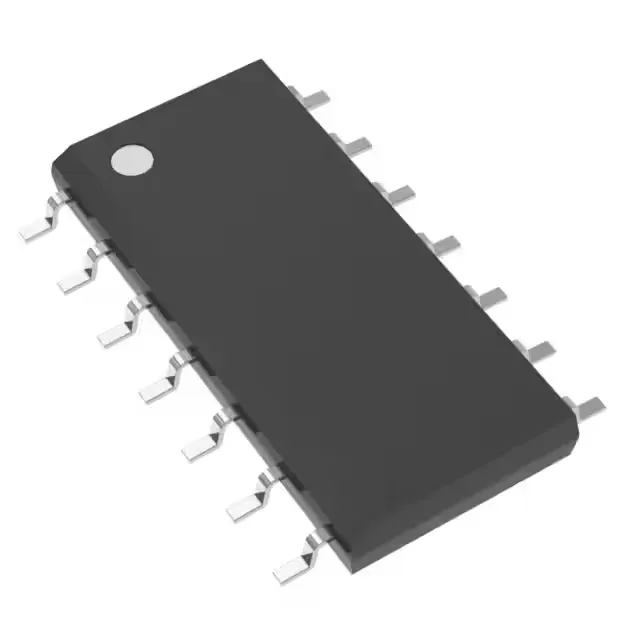
Active production — no BOM risk on this line
Texas Instruments lists the LM224D as Active, so there is no end-of-life clock ticking on this order code. ROHS3 compliant, which means it passes the current EU restriction levels for lead, mercury, cadmium, and the four phthalates — no exemption paperwork needed for a standard commercial assembly line.
The 1.2 MHz gain-bandwidth product sets the usable frequency range at a given closed-loop gain. At a gain of 10, the -3 dB point sits around 120 kHz — enough for audio, sensor filtering, and slow ADC front-ends, but not for video or high-speed data acquisition. Driving a 10 Vpp signal, the output slews at 0.5 V/µs, so a full 10 V swing takes 20 µs — that caps the clean sine wave output to roughly 25 kHz before distortion climbs. For small-signal work (100 mVpp) the slew limit is not the bottleneck; the GBW is.
Supply range and temperature grade — where this part fits
3 V to 30 V supply span means the LM224D runs on anything from a single 3.3 V logic rail up to a ±15 V industrial supply. No need for a separate regulator if the board already carries 24 V — the part takes it directly. -25°C to 85°C ambient temperature range covers most commercial equipment, HVAC controls, vending machines, and indoor industrial panels. It does not reach the -40°C automotive or outdoor telecom band — if the design sees -40°C startup, look at the LM224A or a fully industrial-grade sibling.
Quad channel density in a standard SOIC footprint
Four op-amps in a single 14-SOIC package — the 0.154-inch body width is a JEDEC standard outline that any pick-and-place line handles without special nozzles. Tube delivery is the default for prototype and low-volume runs; reeled tape is available under alternate order codes if the line runs at high volume. 40 mA output current per channel means each amplifier can drive a modest headphone load, a small relay coil through a transistor, or a 2 kΩ load to the rail. For heavier loads, buffer the output with a discrete transistor stage.