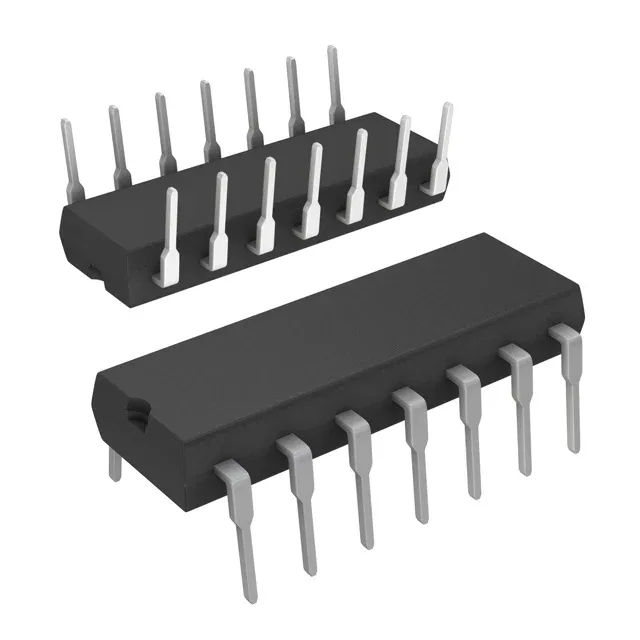
Active production — no LTB pressure on this quad JFET op-amp
The LF347N/NOPB: The part is ROHS3 compliant, so it ships globally without exemption paperwork for the standard 14-DIP package.
Parametric fit for analog signal conditioning
Four J-FET input stages in one 14-DIP package deliver 50 pA typical input bias current — this keeps the voltage error across a 10 kΩ source resistor under 0.5 µV, negligible for most sensor front-ends. The 4 MHz gain-bandwidth product and 13V/µs slew rate mean the amplifier can swing 10 V peak-to-peak at roughly 325 kHz before slew-rate limiting — adequate for audio-band processing and slow control loops. Supply range is 36 V total (min and max both 36 V), which translates to ±18 V split supplies — common for industrial ±15 V rails with headroom for the output stage. Total quiescent current for all four amplifiers is 7.2 mA typical — about 1.8 mA per channel, which keeps the self-heating in the DIP package manageable at 0°C to 70°C ambient.
Through-hole DIP — prototyping and low-volume production
The 14-DIP (0.300", 7.62mm) through-hole package mates with standard DIP sockets or solders directly into plated through-holes — no reflow profile needed, just a wave or hand-solder step. Input offset voltage is 5 mV typical — untrimmed JFET input stage means the DC accuracy is adequate for non-critical paths but may need a trim pot for precision DC-coupled stages. The 0°C to 70°C commercial temperature grade restricts this part to indoor, climate-controlled equipment — not rated for automotive or extended industrial ambient above 70°C.