Active production — BOM-fit for current sensing
The INA2180A2IDGKT: It operates from a 2.7 V to 5.5 V supply span, drawing 355 µA per amplifier, making it suitable for low-power monitoring in battery-powered or industrial control systems.
Bandwidth and slew rate — what they mean for your shunt measurement
The 210 kHz -3 dB bandwidth sets the upper frequency limit for accurate current sensing — above this, gain rolls off and phase delay increases, so it fits DC-to-mid-frequency motor current or power-supply monitoring, not high-speed switching transients. A 2V/µs slew rate means the output can swing 2 V in 1 µs — fast enough to track a step change in load current without significant lag in a typical 10-100 kHz control loop. Rail-to-rail output allows the amplifier to swing close to the supply rails, maximizing the dynamic range of the sensed voltage drop across the shunt resistor — useful when the supply is as low as 2.7 V.
Package and temperature grade for industrial deployment
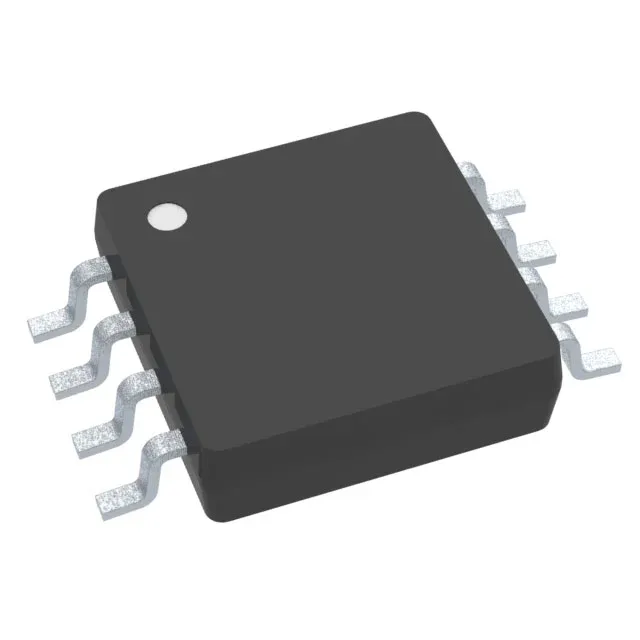
Housed in an 8-VSSOP package (3.00 mm width), the INA2180A2IDGKT is a surface-mount part suited for compact PCB layouts — the 0.65 mm pitch requires careful routing but fits standard 2-layer boards. Rated for -40°C to +125°C ambient, it covers industrial and automotive under-hood temperature ranges without derating — the 100 µV input offset voltage stays within spec across the full band. Input bias current is 80 µA — typical for a current-sense amplifier with internal gain-setting resistors — so the shunt resistor value should be chosen to keep the voltage drop well above the offset floor.