Active production — no end-of-life concern for this current-sense amp
Texas Instruments lists the INA214CIDCKR as Active product status, so there is no NRND or EOL notice to budget for in a production BOM. The part is ROHS3 compliant, which means no RoHS exemption expiry to track on the compliance sheet.
What the 30 kHz bandwidth and 65 µA supply mean for a current-sense node
The gain-bandwidth product is 30 kHz — this amplifier is sized for DC or low-frequency current monitoring (battery charge/discharge, power-supply output, motor winding current at low PWM rates), not for switching-regulator inductor current at hundreds of kHz. Supply current is 65 µA typical, which keeps the self-heating and the load on the sense rail low in always-on monitoring circuits. Input offset voltage is 1 µV typical — low enough that a 10 mΩ shunt at 1 A full-scale produces a 10 mV drop, and the offset contributes only 0.01% error before the gain stage. The 28 µA input bias current is the current drawn into the sense inputs; it flows through the shunt and adds a small voltage drop, so a lower-value shunt (under 100 mΩ) keeps the bias-induced error below 1%.
Supply range and temperature grade — fits 12 V and 24 V industrial rails
Operating from 2.7 V to 26 V, the INA214CIDCKR runs on a 3.3 V or 5 V ADC supply, a 12 V battery rail, or a 24 V industrial bus without an extra regulator. The -40°C to 125°C temperature range covers the full industrial and automotive under-hood ambient, so the offset drift and bias-current shift over temperature stay within the datasheet limits.
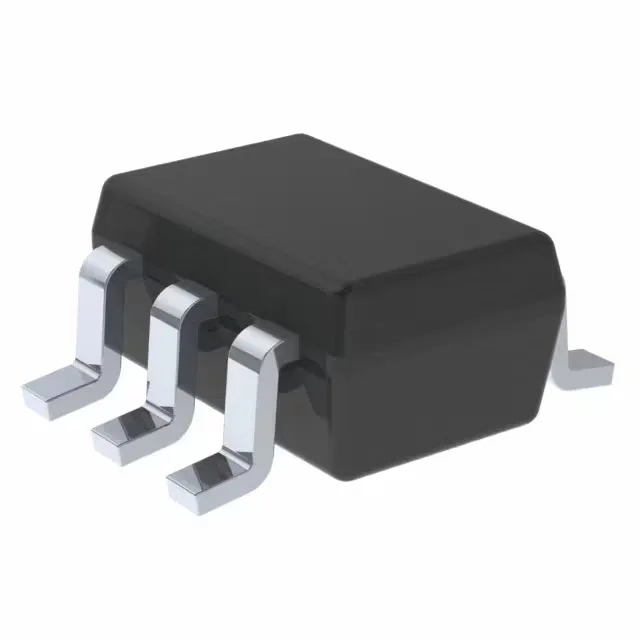
SC-70-6 footprint — small enough for a compact sense module
The 6-pin SC-70-6 (also called SOT-363) package measures roughly 2.0 mm × 1.25 mm, which fits on a small sense board alongside the shunt resistor and a bypass cap. Surface-mount assembly with Tape & Reel packaging means the part is compatible with standard pick-and-place lines and reflow profiles.