What the 14 kHz bandwidth means on your board
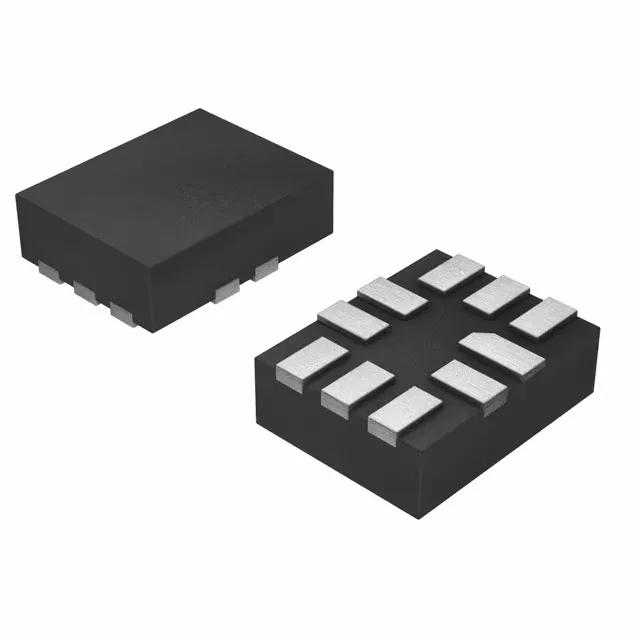
The INA210AIRSWR is a zero-drift current sense amplifier from Texas Instruments' INA210 series, packaged in a 10-UQFN (1.8x1.4 mm) footprint. Its 14 kHz gain-bandwidth product sets the upper limit for the current waveform it can reproduce — above that frequency, the output amplitude rolls off. For a 100 kHz switching regulator, this amplifier captures the average DC current but not the switching ripple; pair it with a downstream filter if you need the average, or step up to a higher-bandwidth part if the ripple envelope matters. The 0.55 µV typical input offset is the zero-drift architecture's main advantage — it does not drift significantly over temperature or time, so a 10 mOhm shunt carrying 1 A produces a 10 mV drop that the amplifier resolves with better than 0.1 % error from the offset alone. The 28 µA input bias current flows into the shunt resistors; with a 1 kOhm shunt network the voltage error from bias is 28 mV, which dominates the offset. Keep the shunt resistance below 100 Ohm to keep bias-induced error under 3 mV.
Supply range and quiescent draw
The amplifier operates from a single supply spanning 2.7 V to 26 V, covering common 3.3 V, 5 V, 12 V, and 24 V rails. The 65 µA typical quiescent current means it adds negligible load to the supply — a battery-powered sensor node that sleeps between measurements loses less than 0.2 mAh per day from this part alone. The 0.4 V/µs slew rate limits the output's ability to follow fast current transients. For a 1 V step at the output, the rise time is about 2.5 µs — adequate for DC load monitoring or overcurrent detection with a microcontroller ADC sampling at a few kHz, but too slow for cycle-by-cycle peak current limiting in a switching converter.
Package and footprint
The 10-UFQFN package (1.8x1.4 mm body, 0.40 mm pitch) is a fine-pitch QFN that requires careful solder-paste stencil design and a reflow profile with a peak temperature around 245 °C. The exposed thermal pad on the bottom is not electrically connected to any pin — it is a thermal pad only. Connect it to a ground-plane copper pour with at least four vias to keep the junction temperature within the -40 °C to 125 °C operating range when the part is dissipating power from the supply rail. The supplier device package designation is 10-UQFN (1.8x1.4) — this is the same physical package as the UFQFN but with a different ordering suffix. The tape-and-reel packaging option (TR) is the standard production reel; cut tape (CT) is available for prototype quantities.