Current-Sense Parametrics for the Shunt Drop Decision
The INA191A3IYFDR is a Zero-Drift current-sense amplifier from Texas Instruments, designed to measure the voltage drop across a shunt resistor in the supply or return path. Its 2.5 µV input offset voltage and 100 pA input bias current let the designer choose a lower-value shunt for reduced power dissipation — the offset error at 10 mV full-scale drop is under 0.025 %, and the bias current drawn from the shunt leg is negligible even with a 1 kΩ series resistance. The 37 kHz gain-bandwidth product and 0.3 V/µs slew rate set the usable sense bandwidth to roughly 5–7 kHz for a 10× gain configuration — adequate for DC load monitoring, battery charge/discharge profiling, and overcurrent detection where the fault response time is tens of milliseconds. Faster transients (switching-edge ring, inrush spikes above 10 kHz) will be attenuated before they reach the ADC input.
Supply Range and Quiescent Draw for Always-On Rails
Operating from 1.7 V to 5.5 V, the amplifier can be powered from a common 1.8 V, 3.3 V, or 5 V rail without an extra regulator. The 43 µA supply current makes it viable for always-on sense circuits in battery-powered equipment — a 1000 mAh cell running the amplifier continuously sees 2.9 years of standby before the sense circuit alone drains it. The rail-to-rail output swings within 10 mV of each supply at light load, preserving the full dynamic range of the downstream ADC. For a 5 V supply with a 100 mV full-scale shunt drop and a gain of 50 V/V, the output sits at 5 V — the rail-to-rail headroom keeps the signal from clipping.
Package and Temperature Grade for Board Integration
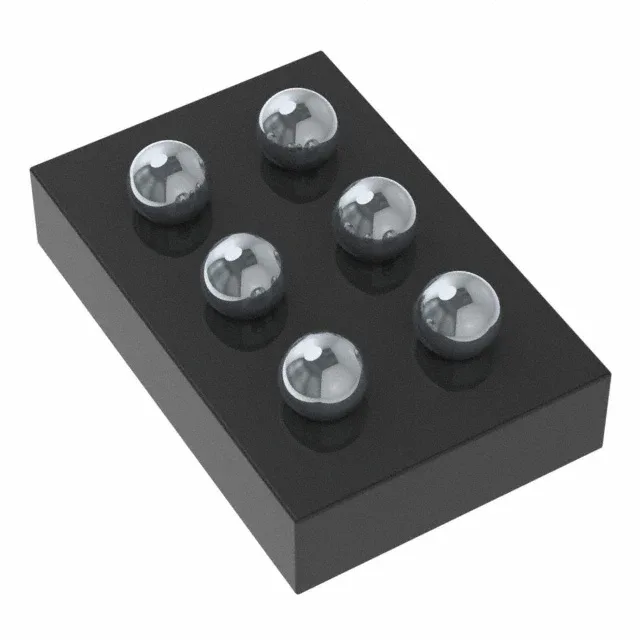
Supplied in a 6-DSBGA package measuring 1.17 × 0.77 mm, the INA191A3IYFDR occupies roughly 0.9 mm² of board area — suitable for space-constrained designs such as battery-pack monitor boards or compact power-management modules. The 0.4 mm ball pitch demands a controlled solder-paste stencil and a 2-layer board with micro-vias for fan-out to the inner layers. Rated for -40°C to +125°C ambient, the part covers the full automotive temperature grade (Grade 1 equivalent) and industrial extended-range applications. The Zero-Drift architecture maintains the 2.5 µV offset across the temperature band — no auto-zero cycling needed, so the sense output stays stable through a cold-crank or hot-soak condition.