Current sense with zero-drift precision
The INA190A5IRSWR is a single-channel current sense amplifier from Texas Instruments' Zero-Drift series, built to measure shunt voltage across a sense resistor with a maximum input offset voltage of 2 µV. That 2 µV offset — combined with a 500 pA input bias current — means the error contribution at the shunt is negligible even when sensing microamp-level load currents, which is the difference between a usable reading and one buried in the amplifier's own DC error.
Bandwidth and supply budget for the BOM
The 27 kHz gain-bandwidth product sets the upper frequency for accurate current measurement — above that, the gain rolls off at 0.25 V/µs slew rate, so the output cannot track fast load transients or switching edges from a downstream DC-DC converter. Supply current is 40 µA typical across the 1.7 V to 5.5 V supply range — low enough that the amplifier's own draw does not dominate the system power budget in a battery-powered sensor node, yet the rail-to-rail output swings to within millivolts of the supply to maximise the ADC input range. The -40°C to 125°C operating range covers industrial and automotive ambient temperature profiles, so the 2 µV offset and 500 pA bias hold across the full thermal envelope without recalibration.
Active lifecycle and compliance
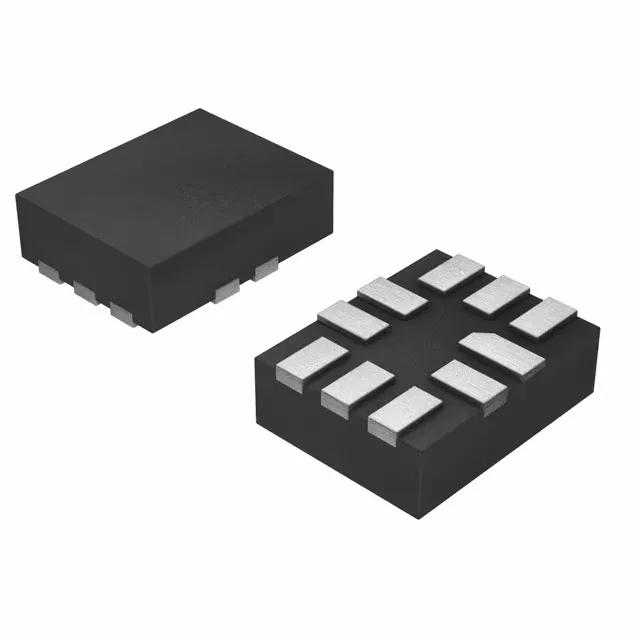
ROHS3 compliant, packaged in Tape & Reel or Cut Tape options, supplied in a 10-UFQFN package (1.8 x 1.4 mm body) that fits tight PCB layouts where board area is the constraint.